Operating question
The strongest new AI signals point away from feature shopping and toward the people, permissions, evidence and recovery steps that make one connected workflow dependable.
AI Operating Models
Daily Signal: Fund the Handoff, Not Just the Tool
For
Leaders and workflow owners
You will leave with
3 operating decisions
Reading mode
11 min · 11 verified sources
Reading guide8 sections · Canadian briefing+
Highest-value moves
- 01Turn one AI ambition into a measured workflow with a named owner, real cases and a clear stop point.
- 02Give every connected assistant an access map, separate identity where possible, expiry and tested revocation path.
- 03Keep a lightweight inventory of tools, data, actions, reviewers and renewal dates before adding more governance software.
Six practical signals on Canadian AI policy, deployment skills, agent security, public inventories, vendor corrections and accountable review.
Today's strongest signal: when a 40-person company is deciding whether to connect AI to its service inbox, quoting system or customer records, the decisive investment is increasingly the handoff around the tool. Canada has created a new council to steer national AI adoption. Anthropic is committing heavily to people who can carry AI from an idea through security review and into real work. Microsoft is warning that useful agents also create new identity and permission paths. AWS has pulled technical guidance while it rechecks the design. None of those signals says a smaller organization needs a grand transformation. Together, they say the surrounding work now deserves its own budget and owner.
The opportunity is practical. A small team can use AI to sort requests, draft options, find approved information and prepare a next action. The tradeoff is that a connected assistant inherits the weaknesses of the records, accounts and processes around it. A realistic reason not to adopt is that the current task may be too rare, poorly documented or difficult to reverse. In that case, improving the source process can create more value than adding a model.
This edition focuses on six moves that fit a Canadian SME: translate national ambition into a local proof, train one workflow owner on real cases, give every agent its own identity, keep a visible inventory, treat vendor guidance as changeable and preserve human review where a system proposes consequential changes.
1. A national AI council makes local evidence more important
What happened. On October 2, the Prime Minister launched a National Council on Artificial Intelligence to advise on Canada's AI for All strategy, including adoption, Canadian companies, sovereign infrastructure, safety and democracy (Prime Minister of Canada). The council can shape direction, but ministers and departments remain responsible for policy and delivery. Canada's published strategy separately identifies six pillars: protection, skills, adoption, sovereign infrastructure, Canadian companies and trusted partnerships (Innovation, Science and Economic Development Canada).
Why a smaller organization should care. Federal attention may lead to training, financing, procurement or infrastructure programs that matter to Canadian suppliers. The opportunity is to become ready for useful support rather than waiting for a perfect program. The tradeoff is planning around announcements whose eligibility, timing and delivery can change. A strategy target is not a purchase order, and a council is not an implementation team inside your business.
A useful first test this week. Write a one-page proof for one workflow: the delay or error today, the data it uses, who accepts the output, the maximum consequence of a mistake, the 30-day measure and the point at which you will stop. Add the Canadian supplier, skills or financing question that would change the decision. That makes the project easier to compare with future programs without bending it to fit every announcement.
What remains uncertain. The October 2 release names the council and its remit, not a new SME application process. Some supports may arrive slowly or favour sectors and projects unlike yours. If the workflow already has a cheap deterministic fix, waiting for an AI program may delay the better answer.
2. The scarce product is someone who can carry the workflow into use
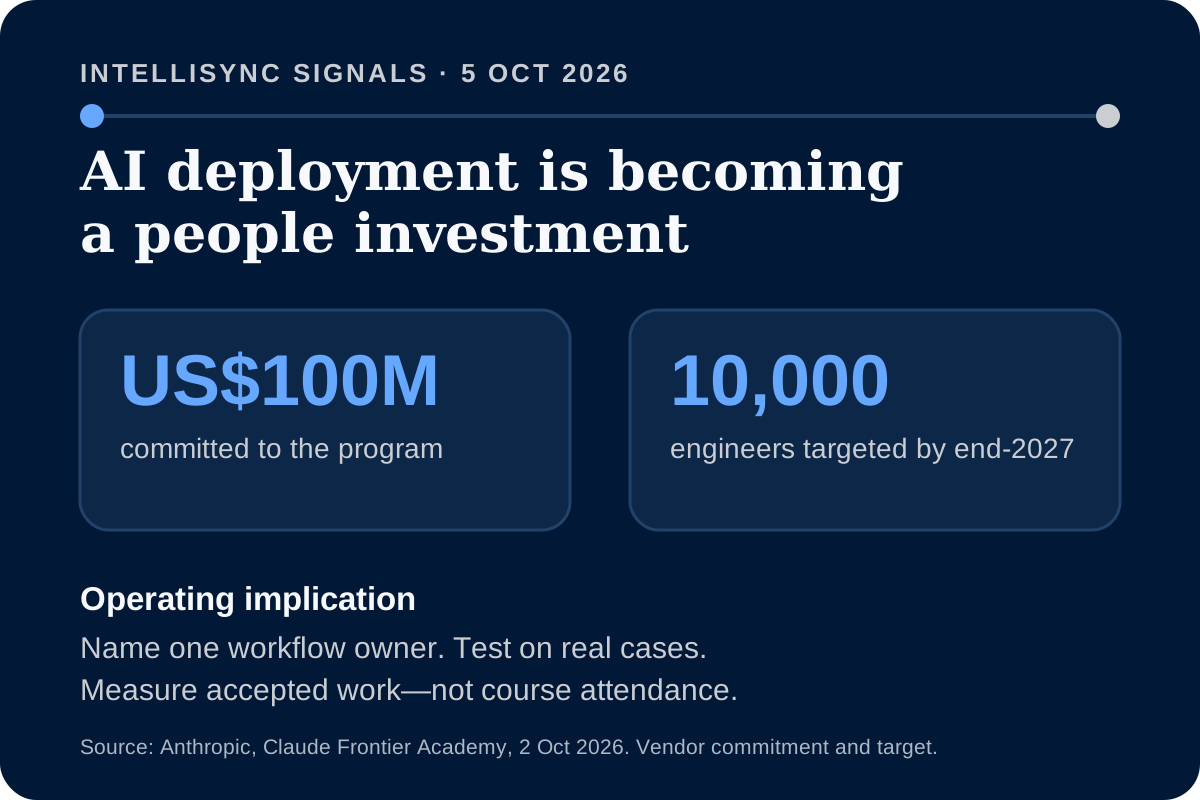
What happened. Anthropic announced a US$100 million commitment to train 10,000 so-called Frontier Deployed Engineers by the end of 2027. Its first program uses simulated deployments, a practical assessment and a 12-week residency tied to a named project at the participant's organization (Anthropic). These are the supplier's commitment and target, not proof that the program will reach them or that its graduates will improve every deployment. The broader labour point is credible: the OECD says AI changes skill needs differently across sectors, regions and roles, so adaptation requires more than a generic course (OECD).
Why a smaller organization should care. The scale is aimed at large enterprises and consulting firms, but the pattern travels down-market. A useful AI workflow needs someone who understands the task, can reach the right records, can work through security and can stay after launch to fix exceptions. The opportunity is to give one capable employee the time and authority to own that path. The tradeoff is concentration risk if only one person understands the system.
Illustrative scenario. A 55-person distributor wants an assistant to prepare renewal quotes. Instead of sending five managers to broad prompt training, it pairs one sales-operations lead with its developer for six weeks. They replay old quotes, document discount approvals and keep a manual fallback. The first release handles only renewals with standard pricing. This scenario is illustrative; it is not an Anthropic customer result.
A useful first test this week. Name one workflow owner and give that person ten historical cases, access to the process owner and a weekly review slot. Measure accepted outputs, correction time, unsafe suggestions and cases that need escalation. Ask a second person to run the documented fallback. Training is useful when the work survives the trained person's absence.
What remains uncertain. Vendor-specific credentials can deepen skill while increasing dependence on one platform. A low-risk tool already embedded in familiar software may not require a specialist role. A reasonable reason not to create a new position is that the workflow can be governed by an existing owner with narrow external help.
3. Every connected agent needs an identity you can remove
What happened. Microsoft's 2026 Digital Defense Report says AI is being used in reconnaissance, social engineering, malware and exploit development, while the familiar foundations of identity, authorization, data protection, least privilege, monitoring, testing and secure development still matter. For agents, the report highlights identity, appropriate access, authentication between agents, attribution and revocation (Microsoft Security). Canada's Cyber Centre likewise warns that generative AI can make phishing text, images, audio and video more convincing, so messages still require verification through trusted channels (Canadian Centre for Cyber Security).
Why a smaller organization should care. A shared service account is easy to create and hard to explain later. If an assistant reads the CRM, drafts email and updates a ticket queue under one employee's account, the team cannot easily tell which action came from the person and which came from the automation. The opportunity is fast, useful work across existing tools. The tradeoff is a new access path that can be misused or left active after the pilot ends.
A useful first test this week. Choose one connected assistant and draw a four-column access table: system, data it can read, action it can take and person who can revoke it. Give the agent its own service identity where the product supports one. Remove unused permissions, set an expiry for the pilot and test the kill switch. Then ask whether the audit log can connect each action to a user request and a specific tool call.
What remains uncertain. Some small-business software does not support separate agent identities or fine-grained permissions. Building a custom layer may cost more than the workflow saves. If the vendor cannot provide attribution and revocation, keeping the assistant read-only or outside the system may be the responsible choice.
4. A visible AI inventory is useful before a larger governance program
What happened. Treasury Board's refreshed responsible-AI page now puts federal guidance, automated-decision rules, ethics material and the Government of Canada AI Register in one public path (Treasury Board of Canada Secretariat). The page presents the register as a list of AI systems used across the federal government. NIST's generative-AI profile offers a compatible lifecycle frame: govern, map, measure and manage risks rather than treating the model as the whole system (NIST).
Why a smaller organization should care. You cannot assign an owner, remove access or answer a customer question about a tool nobody recorded. The opportunity is not a large compliance exercise. A short inventory can reveal duplicate subscriptions, unapproved data flows and high-value uses that deserve support. The tradeoff is maintenance: an inventory becomes fiction if it is updated once and forgotten.
A useful first test this week. Ask each team lead for the AI tools used in paid accounts, free accounts and features inside existing software. Record the workflow, owner, data class, connected systems, output use, human check, renewal date and stop method. Limit the first pass to tools used for work in the last 30 days. Review anything that can send, edit, approve, delete or expose customer data first.
What remains uncertain. A public-sector register is not a ready-made private-sector control, and a spreadsheet will not discover every browser extension or personal account. Monitoring every experiment can also chill useful learning. Keep the first inventory focused on business data and consequential actions, with a clear route for employees to propose a safer approved option.
5. Vendor guidance can change after the demo works
What happened. AWS added an October 2 notice to a technical post about running Apache Kafka with Amazon S3 Files. It removed the implementation guidance while specialists reviewed it and told existing users to test partition limits, latency and failure scenarios before production (Amazon Web Services). This is a storage architecture example, not an AI-agent incident. Its operating lesson is still relevant: even first-party guidance can change after publication.
Why a smaller organization should care. AI-assisted builders often turn tutorials into working prototypes quickly. The opportunity is cheap discovery. The tradeoff arrives when a copied pattern becomes a daily dependency before anyone records the assumptions, version or fallback. A vendor correction is not evidence of negligence; it is evidence that technical advice has a lifecycle.
A useful first test this week. For one prototype moving toward real use, save the exact source links, access date, product versions and assumptions that shaped the design. Test expected volume, a delayed dependency and a failed write. Subscribe to the vendor's security or service notices, and name the person who decides whether a correction requires a pause, patch or rollback.
What remains uncertain. Many tutorials remain useful for years, and a small internal tool using synthetic data may not justify a formal change process. The reason not to add heavy controls is low consequence. The reason to add a release record is that customer data, money or an operational promise now depends on the pattern.
6. AI can propose a change without owning the decision
What happened. Ontario's 2026 Burden Reduction Report describes REGi, a large-language-model tool connected to e-Laws that helps policy teams find requirements that may be outdated or unnecessarily complex. It says policy and legal experts still review proposed changes and that the tool does not change rules automatically. The report also describes exploration of AI to help identify mining-permit gaps and dependencies while supporting, not replacing, government expertise (Ontario). Ontario's responsible-use directive provides the wider rule: ministries and agencies must assess and manage risk for procured, developed and publicly available AI used in programs, services or decisions (Ontario Responsible Use of AI Directive).
Why a smaller organization should care. This is a recognizable division of work. AI can scan a large rule set, surface a likely conflict and prepare a review packet. A qualified person can decide whether the rule applies and whether the change is acceptable. The opportunity is less searching and a more complete first pass. The tradeoff is review load and the chance that a fluent suggestion anchors the reviewer too early.
A useful first test this week. Pick one policy-heavy task such as checking contract renewals, safety forms or permit requirements. Let the tool produce a list of possible gaps with source links, but block it from updating the record. Give the reviewer an independent checklist and require a reason for accepting or rejecting each suggestion. Compare missed items and review time with the existing method.
What remains uncertain. Ontario's examples concern government policy and permitting, not a private company's legal obligations. The source does not prove accuracy or savings for your workflow. If the decision is rare, highly contextual or difficult to correct, expert review without an AI first pass may remain the simpler choice.
Highest-value moves
- Write a one-page proof for one workflow, including the owner, data, measure, maximum consequence and stop point.
- Give one connected assistant its own access map, expiry, audit trail and tested kill switch.
- Build a 30-day AI inventory and review consequential writes before duplicate subscriptions or broad experiments.
Today's strongest thesis
The tool starts the workflow; the funded handoff is what makes the result dependable.
Verified sources
- Prime Minister of Canada: Prime Minister Carney launches new National Council on Artificial Intelligence
- Innovation, Science and Economic Development Canada: Overview of Canada's National Artificial Intelligence Strategy: AI for All
- Anthropic: Claude Frontier Academy: $100M to train 10,000 engineers
- OECD: Skills in the AI age
- Microsoft Security: Insights from the 2026 Microsoft Digital Defense Report
- Canadian Centre for Cyber Security: Don't take the bait: Recognize and avoid phishing attacks
- Treasury Board of Canada Secretariat: Responsible use of artificial intelligence in government
- National Institute of Standards and Technology: Artificial Intelligence Risk Management Framework: Generative Artificial Intelligence Profile
- Amazon Web Services: Running Apache Kafka with Amazon S3 Files
- Government of Ontario: 2026 Burden Reduction Report
- Government of Ontario: Responsible Use of Artificial Intelligence Directive
Continue your decision path
Move from understanding to action.
AI Implementation Brief
Turn this edition's decision points into a concrete working plan.
Daily Signal: Turn AI Intent Into One Working Workflow
Six practical signals on Canadian AI adoption, identity checks, bounded agents, data location, value ownership and human review.
Read nextApply this signal to your architecture.
Identify the workflow, context, and controls to structure first.
Open Architecture Assessment