Operating question
New Canadian funding and rapidly changing AI controls reward teams that can show one workflow's baseline, authority, evidence and safe stopping point.
Decision Architecture
Turn the Funding Window Into a Measurable Workflow
For
Leaders and workflow owners
You will leave with
4 operating decisions
Reading mode
11 min · 11 verified sources
Reading guide8 sections · Canadian briefing+
Highest-value moves
- 01Canada's expanded AI adoption funding favours workflows with measurable baselines, owners and evidence.
- 02Reusable evaluations let a smaller organization compare models and explain changes without rebuilding trust each time.
- 03Model access, reasoning effort and policy freshness are business controls, not only technical settings.
- 04Edge AI can reduce latency and data movement while increasing device, update and recovery responsibilities.
Canada's new AI funding window, tighter model controls and edge trust shifts point to one move: make a single workflow measurable before scaling it.
Today's strongest signal: a Canadian operations lead can now see new public funding, more capable AI services and tighter controls arriving at the same time. The practical opening is not “buy more AI.” It is to take one costly, repeatable workflow and make its outcome, evidence and owner clear enough to fund, test and stop.
That matters in a recognizable business situation. A manufacturer may have quoting delays, a professional firm may rework intake notes, or a distributor may spend Friday reconciling order exceptions. Each can describe an AI idea. Far fewer can show the baseline time, the permitted data, the decision owner, the error limit and the proof that would justify a second step.
The past 72 hours make that gap more important. Canada opened a larger adoption program. Canada and the United Kingdom renewed joint work on AI security evaluation. GitHub added another model and stronger policy freshness controls. AWS published a useful example of trading more reasoning for more cost. California reported public input on AI policy. Arm and Qualcomm showed why trust and processing location are becoming architecture choices.
1. A $500-million expansion rewards funding-ready workflows
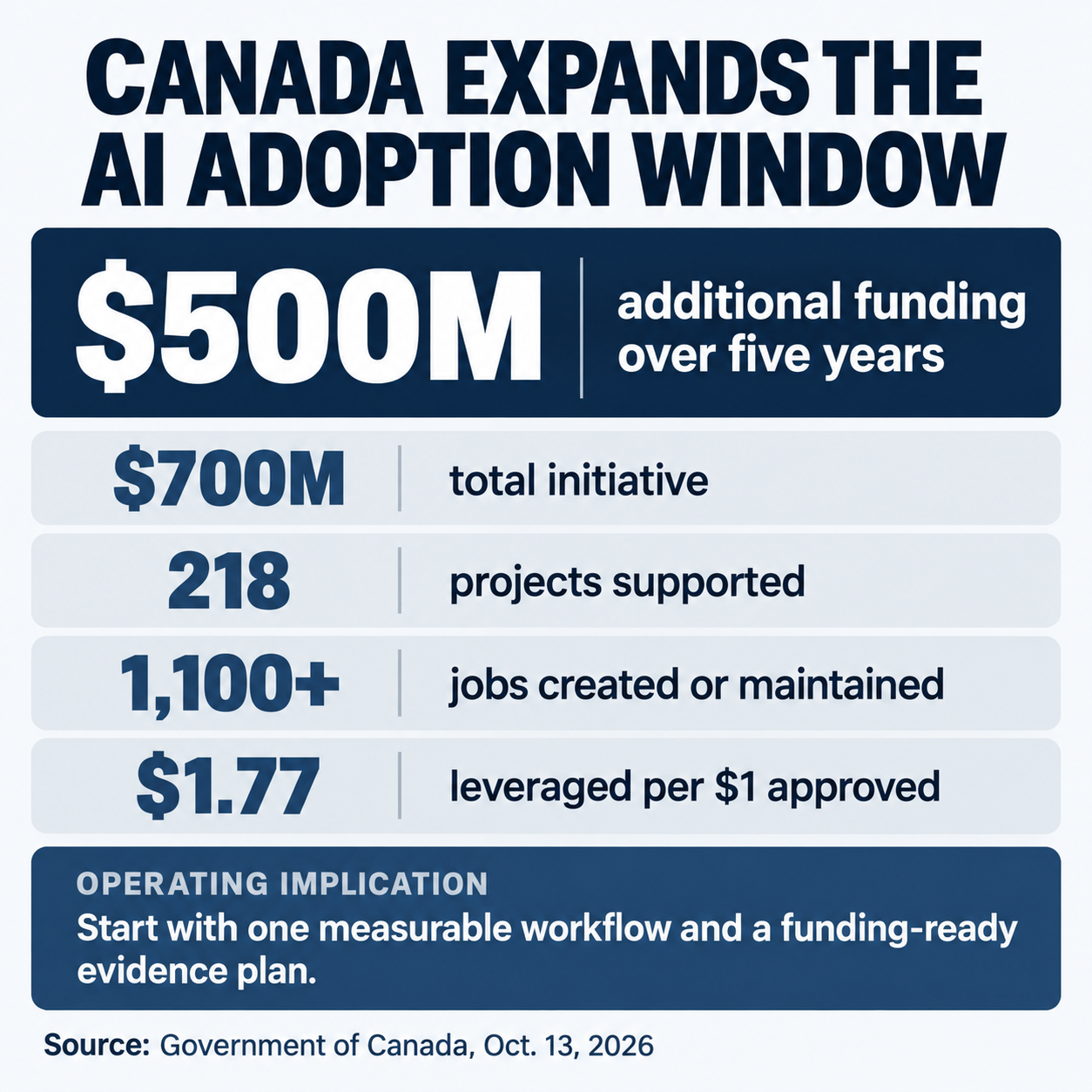
On October 13, the Government of Canada announced an additional $500 million over five years for the Regional Artificial Intelligence Initiative, bringing total federal funding for the initiative to $700 million. The program is meant to help organizations adopt AI responsibly and help Canadian AI firms commercialize and scale. The same release says earlier activity supported 218 projects, created or maintained more than 1,100 jobs and leveraged about $1.77 for every approved dollar (Government of Canada).
Those figures do not guarantee that any one application will succeed. They do show that AI adoption is being treated as an operating investment, not a software-shopping exercise. In southern Ontario, organizations can apply under an AI Adoption stream or an AI Ecosystem stream, but not both, and early costs can remain at the applicant's risk until a formal decision is made (FedDev Ontario). Ontario's earlier budget direction also ties adoption to productivity, clear governance and sector use cases rather than general experimentation (Ontario Ministry of Finance).
A useful first test this week is to write a one-page evidence brief for one workflow. Record its current cycle time, error or rework rate, monthly volume, data owner, approval point and a 30-day target. Then ask whether funding changes the economics or merely makes a vague idea larger.
Illustrative scenario: a 45-person parts supplier chooses quote preparation, not “sales transformation.” It measures the time from a complete request to a review-ready draft, keeps pricing approval with the sales manager and excludes incomplete requests from automation. The funding case is now tied to throughput and control.
What remains uncertain is program fit, timing and the amount available to a particular applicant. A realistic reason not to apply is that the workflow has no stable baseline or accountable owner yet. In that case, two weeks of measurement may create more value than a rushed application.
2. Shared AI security work raises the value of reusable evaluations
Canada and the United Kingdom renewed their AI security partnership on October 13. The agreement focuses on information sharing about frontier-model risks and capabilities, evaluation practices, possible staff exchanges, coordinated evaluations and interoperable technical standards (Innovation, Science and Economic Development Canada).
For a smaller organization, the immediate lesson is not to build a national-security lab. It is to stop treating each vendor demo as a fresh act of faith. An evaluation can become reusable business infrastructure when it records the task, test data, expected answer, unacceptable action, human reviewer and pass condition. The same packet can compare models, support procurement and make a later incident easier to explain.
This is especially useful when a workflow can affect money, customers, staff or regulated information. “The assistant looked careful” is not a repeatable result. A test set with known answers, seeded failure cases and preserved outputs is. It also keeps the organization from confusing a model update with a completed business decision.
A useful first test is to select ten real but de-identified cases from one workflow. For each, define the acceptable answer and one failure that requires escalation. Run the current tool twice. If the results vary, record the pattern before changing the prompt or provider. The aim is not a perfect score from a tiny sample; it is a test you can run again.
The opportunity is faster, more defensible comparison across suppliers. The tradeoff is maintenance: cases age, policies change and a benchmark can become theatre if nobody owns it. A realistic reason not to automate evaluation yet is low case volume. Manual review of every output may remain cheaper and safer while the team learns what failure actually looks like.
What remains uncertain is how quickly joint government work will produce standards that ordinary buyers can use directly. Do not wait for a finished standard to preserve your own evaluation evidence.
3. New model access makes administrator defaults a business decision
GitHub made Gemini 4 Argon generally available in GitHub Copilot on October 13 for several paid plans. The release says access can be managed through model policy and notes that, under default enablement, new models can become available unless an administrator has disabled the global default or the model itself (GitHub).
On the same day, GitHub added a way for supported clients to require a fresh copy of managed settings at startup. When that control is active and current policy cannot be confirmed, the client fails closed instead of using stale policy. GitHub also began tying governance-sensitive settings such as sandboxing to minimum client versions (GitHub).
The overlooked point is that a model picker is now part of change management. A new model may improve coding or reasoning, but it can also change cost, output style, tool behaviour and the evidence available to reviewers. Default-on access is convenient for exploration; it is less useful when a team assumes yesterday's approved setup is still in force.
A useful first test is an inventory, not a ban. List the AI tools used in one team, who can enable a model, whether settings are centrally managed, what happens when policy cannot refresh and which client versions remain in use. Then choose one rule that truly needs fail-closed behaviour, such as sandbox enforcement or access to a customer repository.
The opportunity is faster access to stronger capability without a separate deployment project. The tradeoff is that central controls add support work and may interrupt users during a network or version problem. A realistic reason not to force a remote refresh everywhere is that some staff need resilient offline work and the affected task carries little risk.
What remains uncertain is how Gemini 4 Argon performs on your codebase and review standards. Vendor benchmark language is a reason to test, not a substitute for your own acceptance cases.
4. Reasoning effort is becoming a cost-and-quality control
AWS published a long-horizon agent example on October 13 using four reasoning-effort levels. Across three synthetic tasks run six times at each level, the agent returned 67 correct answers in 72 runs. The highest effort answered all 18 of its runs correctly, while the low setting answered 15 of 18 and used about one eighth of the output tokens. AWS is explicit that the tasks were synthetic, short proxies and not a production guarantee (AWS).
The business signal is simple: “use the best model” is too coarse. The same workflow may need a fast, inexpensive route for ordinary cases and a slower route for exceptions. Reasoning effort means how much internal work a model is allowed to do before answering. More can improve a difficult result, but it can also add tokens, latency and cost without helping a routine case.
A useful first test is to define three case classes for one workflow: routine, ambiguous and consequential. Give each a measurable pass condition and a maximum wait time. Run several examples at a lower and higher effort. Compare completed-task cost and review corrections, not just the first answer's polish.
The opportunity is to spend capability where uncertainty warrants it. The tradeoff is routing complexity: someone must define escalation rules, monitor actual usage and notice when a “routine” case is not routine. A realistic reason not to add dynamic routing is low volume. One conservative configuration may be cheaper than maintaining a clever policy.
What remains uncertain is whether AWS's reported tradeoff transfers to your provider, prompt, tools and data. It probably will not transfer as a neat ratio. The method is the useful part: provable tasks, repeated runs, actual token counts and explicit limits.
5. AI governance is starting with the people affected
California released results from a statewide public-engagement exercise on AI policy on October 13. The report is presented as evidence that residents want a voice in how AI is built, used and governed (Office of Governor Gavin Newsom).
A Canadian SME does not need a statewide consultation. It does need to hear from the people who live with a workflow before deciding that automation is useful. Operators often know where inputs are incomplete, where customers need an explanation and where a nominally simple exception can consume an afternoon. That knowledge rarely appears in a vendor deck.
A useful first test is a 30-minute pre-mortem with three roles: the person who does the work, the person who receives the result and the person who owns the risk. Ask each to name one helpful outcome, one unacceptable shortcut and one signal that the system needs human review. Turn the answers into acceptance tests.
The opportunity is better design and earlier adoption because staff can see their concerns in the workflow. The tradeoff is that consultation takes time and can surface disagreements that delay a launch. That delay may be useful. It is cheaper to discover that sales and finance define an “approved quote” differently before an agent starts drafting them.
A realistic reason not to run a broad consultation is scope. For a low-risk personal productivity aid, a small user test may be enough. Do not create a committee for a reversible experiment.
What remains uncertain is how California's process will shape enforceable policy. For business operators, the near-term point is narrower: people affected by a system are a source of operational evidence, not merely a communications audience.
6. Edge AI pushes trust into the device and network
Arm argued on October 13 that confidential AI needs interoperable attestation across processors, accelerators, firmware, software and services. Attestation is evidence about a system's identity and state that another party can evaluate before trusting it. Arm points to shared work around the Internet Engineering Task Force's RATS architecture and open-source implementation efforts, while noting that some newer specifications remain unfinished (Arm). The underlying IETF architecture separates evidence, verification and the relying party's trust decision (IETF).
Qualcomm's October 12 broadband announcement shows the other half of the shift: more inference and network management can happen on gateways and edge infrastructure rather than only in a distant cloud (Qualcomm).
For a smaller organization, edge AI may reduce latency, bandwidth use or exposure of sensitive data. It also adds assets to patch, monitor and retire. “Runs locally” does not automatically mean private, secure or manageable. The device still needs an identity, a software-update path, logging, recovery and a rule for what happens when it cannot prove its state.
A useful first test is to map one proposed edge use case—quality inspection, a site gateway or an on-device assistant. Record what data stays local, what leaves, who verifies software state, how updates are signed, how long logs are retained and what safe mode takes over during failure.
The opportunity is responsive capability closer to work. The tradeoff is a wider fleet of hardware and software combinations. A realistic reason not to move inference to the edge is that the workload is occasional and ordinary cloud processing already meets privacy, latency and cost needs.
What remains uncertain is how quickly emerging attestation work becomes easy to buy and operate across vendors. Until then, ask suppliers for concrete evidence and lifecycle responsibilities, not a general promise of “confidential AI.”
Highest-value moves
- Choose one workflow and record its baseline, owner, data boundary, approval point and 30-day measure before discussing funding or models.
- Build a ten-case evaluation packet that can be rerun when a model, policy or client version changes.
- Map where each AI task runs, what it may access and the safe fallback when policy, evidence or connectivity is missing.
Today's strongest thesis
The best AI opportunity this week is the one your team can measure clearly enough to fund, govern and stop.
Verified sources
- Government of Canada: Government of Canada expands support to adopt and commercialize artificial intelligence
- FedDev Ontario: Regional Artificial Intelligence Initiative for organizations: When to apply
- Ontario Ministry of Finance: 2026 Ontario Budget: Chapter 1B — Economy
- Innovation, Science and Economic Development Canada: Canada and the United Kingdom Renew Their Partnership on Artificial Intelligence Security
- GitHub: Gemini 4 Argon in GitHub Copilot
- GitHub: Enterprise managed settings enforcement updates
- AWS: Build long-horizon agents with Grok 4.7 on Amazon Bedrock
- Office of Governor Gavin Newsom: Governor Newsom announces results from California's first-in-the-nation project to involve Californians in decisions about AI
- Arm: Scaling trust in confidential AI requires a common language
- Internet Engineering Task Force: Remote ATtestation procedureS (RATS) Architecture
- Qualcomm: Qualcomm Unveils AI-Native Broadband Innovations Across Fiber, Wi-Fi 8, Fixed Wireless, and Network Infrastructure and Security at Network X 2026
Continue your decision path
Move from understanding to action.
Operating Architecture Canvas
Turn this edition's decision points into a concrete working plan.
Daily Signal: Put the System of Record Before the Agent
Seven practical signals on work agents, clean records, voice privacy, provider concentration, policy changes, security remediation and industry context.
Read nextApply this signal to your architecture.
Identify the workflow, context, and controls to structure first.
Open Architecture Assessment