Operating question
AI becomes dependable when business meaning, authorization and evidence travel with the workflow instead of living in separate policies, copied data or after-the-fact review.
Decision Architecture
Put the Rule Where the Work Runs
For
Leaders and workflow owners
You will leave with
4 operating decisions
Reading mode
11 min · 9 verified sources
Reading guide8 sections · Canadian briefing+
Highest-value moves
- 01Funding creates value when it is tied to one measurable workflow, a named owner and a retained result.
- 02AI-ready data needs explicit business meaning, ownership and lineage, not only cleaner tables.
- 03Agent security improves when runtime limits, identities and approval rules sit outside the model.
- 04Reusable tests and source-system permissions turn broad assurance promises into operating evidence.
New Canadian investments and agent controls point to one practical move: keep rules, context and proof close to every AI-assisted action.
Today's strongest signal: the useful AI move is becoming easier to describe and harder to fake. A food processor deciding whether to automate inspection, a farm researcher ranking crop candidates, or an office team connecting an agent to finance data now faces the same practical question: can the business rule travel with the work?
Over the preceding 72 hours, Canadian investments moved AI toward specific food and crop workflows. Microsoft described data readiness as a continuing business capability. Security leaders pushed controls outside the model. Assurance programs turned broad safety language into tests. Workday put permissions, approvals and audit trails under agents that can act without a person opening the application.
The common thread is placement. A policy in a binder, a data definition in one analyst's head, or an approval that appears only after something goes wrong will not reliably govern an active workflow. Smaller organizations do not need the largest platform to respond. They need one measurable job, rules close to the action, and evidence that survives the demo.
1. Funding is most useful when it buys a better workflow
The Canadian Food Innovation Network announced a $50 million federal investment intended to help food and beverage processors, especially smaller firms, adopt automation, AI and digital manufacturing. The program is expected to support more than 200 SMEs, facilitate up to $200 million in follow-on investment and create about 300 new jobs (Canadian Food Innovation Network). Those are targets, not promised results for any applicant.
The operating opportunity is not simply cheaper software. Food processing contains visible, repeated work: checking labels, forecasting batches, spotting downtime, tracing ingredients, scheduling sanitation and documenting quality. A focused project can connect technology spending to throughput, waste, labour time or a release decision that already matters.
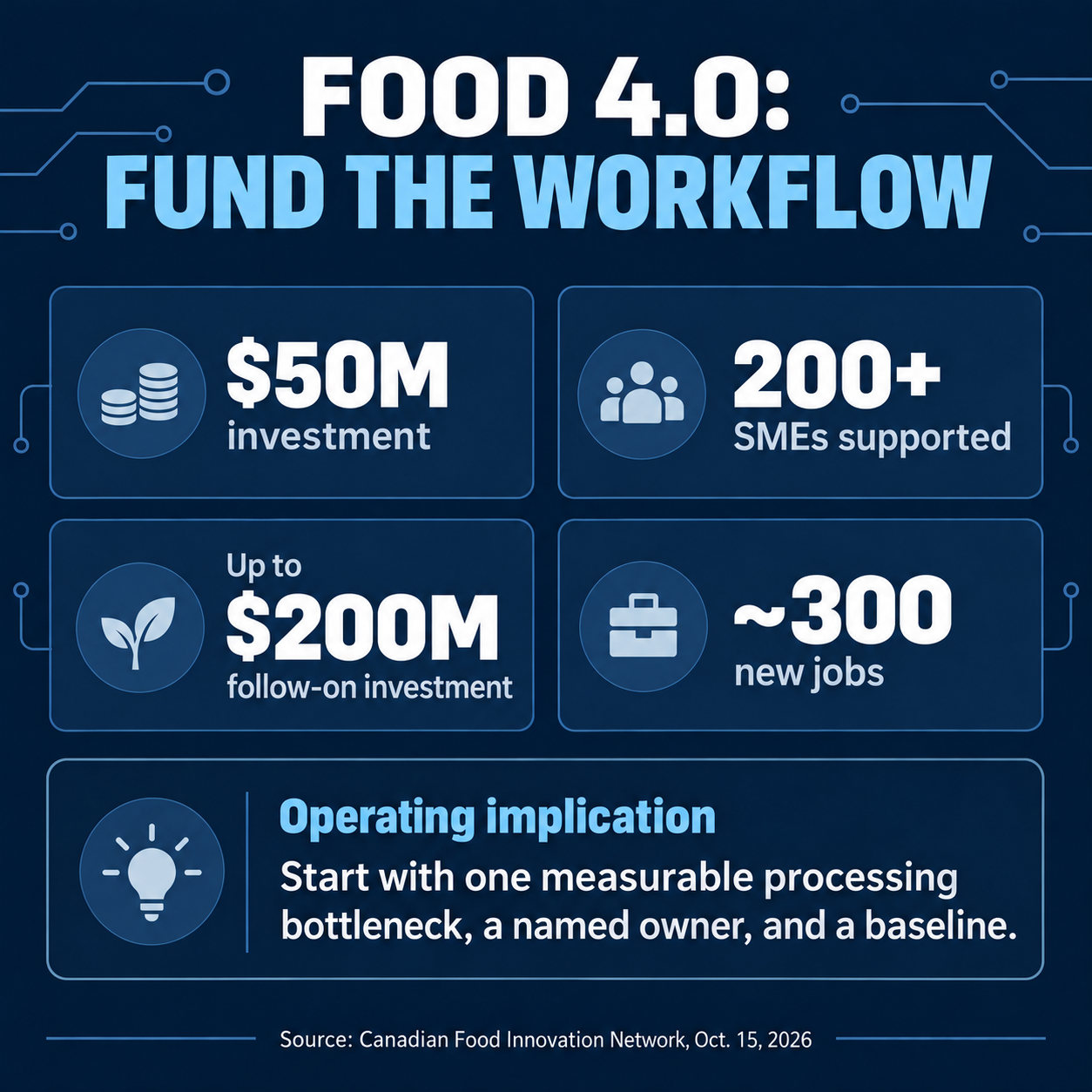
A useful first test this week is to choose one bottleneck and record five things before contacting a vendor: the current cycle time, the error or rework rate, the monthly volume, the person who approves an exception and the business result after 30 days. If the baseline cannot be measured, funding may enlarge a vague idea rather than improve a process.
Illustrative scenario: a 38-person specialty food producer does not begin with “AI transformation.” It begins with label verification before a production run. The team measures late label changes and hours spent comparing specifications, lets a tool flag mismatches, and keeps final release authority with quality assurance. The investment case now describes a workflow, a limit and a receipt.
The tradeoff is implementation load. Equipment integration, data cleanup, staff training and supplier support can consume the capacity the funding is meant to unlock. A realistic reason not to apply yet is that no one owns the process or the current numbers. What remains uncertain is the amount, timing and fit available to any one company. Two weeks of measurement can be a better first investment than a rushed application.
2. Research value depends on the validation path, not the AI label
Agriculture and Agri-Food Canada announced support for Céréla to use AI in developing soybean and barley varieties suited to Eastern Canadian growing conditions. The work targets traits such as disease resistance and is intended to accelerate the path from candidate selection to useful varieties (Agriculture and Agri-Food Canada). The announcement establishes a research direction; it does not prove that a particular variety will perform in every field.
For a smaller organization, the lesson extends beyond agriculture. AI can narrow a large search space: candidate materials, maintenance causes, product configurations or possible suppliers. That can save expert time. It does not remove the physical, commercial or regulatory test that makes the answer usable.
A useful first test is to draw the validation chain for one AI-supported decision. Name the input data, the model output, the expert review, the field or production test, the acceptance threshold and the person allowed to advance the candidate. Then ask where a false positive costs time and where a false negative hides opportunity.
The opportunity is faster learning. A small team can spend scarce expert attention on the most promising options instead of checking every option equally. The tradeoff is that historical data can reward yesterday's conditions, while weather, suppliers or customer needs change. A realistic reason not to adopt the capability is a small candidate pool that experts can already review cheaply and accurately.
What remains uncertain is the size and consistency of the acceleration outside the named research program. The useful operating principle is modest: let AI prioritize the queue, but keep the proof step tied to the real environment. A model can recommend which seed to test; the field still gets a vote.
3. Data becomes AI-ready when its meaning has an owner
Microsoft described an internal data-readiness approach that combines quality with governance, discoverability, business context, ownership, lineage, security and observability. Its central point is that readiness is continuous because data, systems and requirements keep changing (Microsoft). The article also gives a revealing example: an internal data set named “Pigeon” was interpreted literally when the business context was missing.
This matters to an SME because many AI failures that look like weak reasoning are actually missing definitions. “Active customer,” “gross margin,” “urgent order” and “approved supplier” often mean different things across sales, finance and operations. A model connected to all three systems gains more rows, not automatic agreement.
A useful first test is to select one field used in a consequential report or workflow. Write its plain-language meaning, owner, source system, refresh expectation, permitted users and known exceptions. Give the description to someone outside the department. If they cannot apply it consistently, an agent will not repair the ambiguity by sounding fluent.
The opportunity is reuse. Once a definition, owner and lineage are explicit, the same context can support reports, automation, retrieval and audit. The tradeoff is ongoing care. Metadata ages, ownership changes and exceptions multiply. A realistic reason not to build a broad readiness program is that one narrow workflow uses a stable, well-understood table; document that seam instead of launching an enterprise catalogue.
What remains uncertain is which readiness score or tool will transfer across companies. Microsoft is describing its own evolving practice, not a universal standard. The durable move is to make meaning inspectable and assign a person who can correct it. Clean data without business context is organized uncertainty.
4. Agent security is moving outside the model
The Cyber Security Agency of Singapore and Google reported on a scenario exercise involving autonomous agents. Participants emphasized runtime monitoring, hardened execution environments, strict access controls and deterministic guardrails for high-impact actions. They also warned that perimeter defences or manual review alone can leave gaps or create bottlenecks (Cyber Security Agency of Singapore).
The same week, Perplexity made its SPACE sandbox available as open source, according to Semafor. A sandbox is an isolated place where code can run with limited access to the host and other systems. The public repository exposes the implementation and documentation for teams to inspect rather than relying only on a product claim (Semafor; SPACE repository).
For a smaller organization, this does not mean self-hosting a new security platform. It means treating the model as one untrusted component inside a controlled job. The agent can suggest a command, but a separate rule can restrict the directory. It can request a payment action, but a deterministic limit and named approver can stop it. It can read a temporary file, but the environment can disappear after the task.
A useful first test is to run one agent with a deliberately narrow identity. Give it only the files, tools, network destinations and time window needed for the task. Inject a request that should be refused or blocked. Confirm the block in the event record, then remove the identity and check that access is gone.
The opportunity is more useful automation without handing one model a standing master key. The tradeoff is engineering and support overhead; isolation, credential brokering and logs can make a simple task expensive. A realistic reason not to use an autonomous agent is that a deterministic script or a person can complete the same low-volume job more safely.
What remains uncertain is how well any new sandbox performs against future techniques and each organization's surrounding systems. Open source improves inspectability, not immunity. The safe claim is narrower: place hard limits outside the model and test the full route, including credentials, tools and recovery.
5. Assurance becomes useful when it ends in a test record
Singapore's Infocomm Media Development Authority announced new AI-safety and resilience initiatives, including a starter kit for testing agentic systems and access to accredited assessment providers. The program frames assurance as layered work across guidance, evaluations and cyber defence rather than a single certification (Singapore Government Press Centre).
“Assurance” means evidence that a system behaves within an agreed boundary. For an SME buyer, the word can otherwise become a polished promise with no reusable proof. A useful assurance record names the version tested, the task, the data, the expected result, the unacceptable action, the evaluator and the date.
A useful first test is to build ten cases from real work, with private details removed. Include ordinary requests, incomplete inputs, a sensitive-data request, an unavailable tool, a misleading instruction inside a document and one case where the correct answer is to stop. Keep the outputs and reviewer decisions. Repeat the set after a model, prompt, connector or policy changes.
The opportunity is faster comparison. The same cases can support procurement, release review and incident analysis. The tradeoff is maintenance: a test pack becomes theatre if it never changes with the workflow. A realistic reason not to hire an outside assessor is a low-risk internal experiment with no external users or consequential actions; a small in-house test may be proportionate.
What remains uncertain is how portable the new methods and provider results will be across sectors and jurisdictions. Accreditation can improve confidence in the process, but the buyer still owns the local acceptance boundary. The aim is not to prove that an agent is “safe.” It is to show what was tested, what passed, what failed and who accepted the remaining risk.
6. The strongest permission is the one the action cannot bypass
Workday announced a platform that lets agents built with different models and frameworks act against HR and finance workflows while remaining under Workday permissions, approvals and audit trails. Its agent harness also provides traces, evaluations, regional routing and guardrails (Workday). A related data-cloud announcement argues that agents need live business context without requiring teams to extract data and rebuild its security elsewhere (Workday Data Cloud).
The operating signal is bigger than one vendor. When an agent acts through a shared system account or a copied data lake, it can lose the rules attached to the original employee, customer, invoice or approval. Moving the agent closer to the system of record can preserve those rules, but only if authorization is evaluated for each action and the evidence is retained.
A useful first test is to choose one read and one write in an existing system. Ask who may perform each action, which fields they may see, which threshold requires approval, how a denial appears and what receipt an auditor can retrieve later. Test with an allowed identity and a disallowed one. A successful answer is not enough; the denied route is part of the product.
The opportunity is to let teams use different models without rebuilding the business rule for every assistant. The tradeoff is platform dependency and configuration work. A realistic reason not to adopt a vendor harness is that the workflow spans several systems with inconsistent identities; pretending one platform governs the whole route may create false confidence.
What remains uncertain is how the announced capabilities behave across each customer's configuration, integrations and future releases. Vendor language such as “lawful” is a design claim, not legal advice. The practical standard is observable: the same person, data and transaction rules apply whether a human clicks the button or an agent requests the action.
Highest-value moves
- Pick one workflow and record its baseline, owner, approval point and evidence before seeking funding or buying another tool.
- Put hard limits around one agent identity, then test an allowed action, a blocked action and credential removal.
- Define one business term at its source and reuse that definition in the report, automation and review record.
Today's strongest thesis
AI becomes operational when the rule, the context and the proof arrive at the action together.
Verified sources
- Canadian Food Innovation Network: Canadian food innovation investment
- Agriculture and Agri-Food Canada: AI crop research for Eastern Canada
- Microsoft: AI-ready data at Microsoft
- Cyber Security Agency of Singapore: Agentic AI security and control exercise
- Semafor: Perplexity open-sources SPACE
- Perplexity: SPACE agent sandbox repository
- Singapore Government Press Centre: Singapore AI safety and resilience initiatives
- Workday: Workday Trusted Agent Platform
- Workday: Workday Data Cloud
Continue your decision path
Move from understanding to action.
Decision Guardrail Canvas
Turn this edition's decision points into a concrete working plan.
Make the Default Prove It Is Current
Fast-changing AI models, policies, telemetry and agents point to one practical move: verify the active state before trusting the output.
Read nextApply this signal to your architecture.
Identify the workflow, context, and controls to structure first.
Open Architecture Assessment