Operating question
AI delegation becomes useful when every workflow can show its scope, data, actions, unit cost and human owner in evidence a person can review.
Decision Architecture
Make the Receipt Part of the Work
For
Leaders and workflow owners
You will leave with
4 operating decisions
Reading mode
12 min · 9 verified sources
Reading guide8 sections · Canadian briefing+
Highest-value moves
- 01Measure AI cost and speed per accepted result, including the human corrections needed to make it usable.
- 02Build consent, correction and deletion into the workflow before customer or employee data enters model context.
- 03Enforce agent scope with identity and tool permissions rather than depending on a polite model instruction.
- 04Use funding and advisory help to narrow one measurable workflow instead of enlarging an undefined AI project.
New cost, privacy, security and Canadian adoption signals point to one practical rule: delegate only when the workflow returns usable evidence.
Today's strongest signal: the useful AI workflow is becoming the one that can hand you a receipt for what it did, what it cost, what data it used and who still owns the decision. Think about a service manager who receives fifty requests on Monday morning. An assistant may sort them quickly. The business question is whether the manager can see which requests were read, which rules were applied, which cases were held back and whether the time saved was worth the bill.
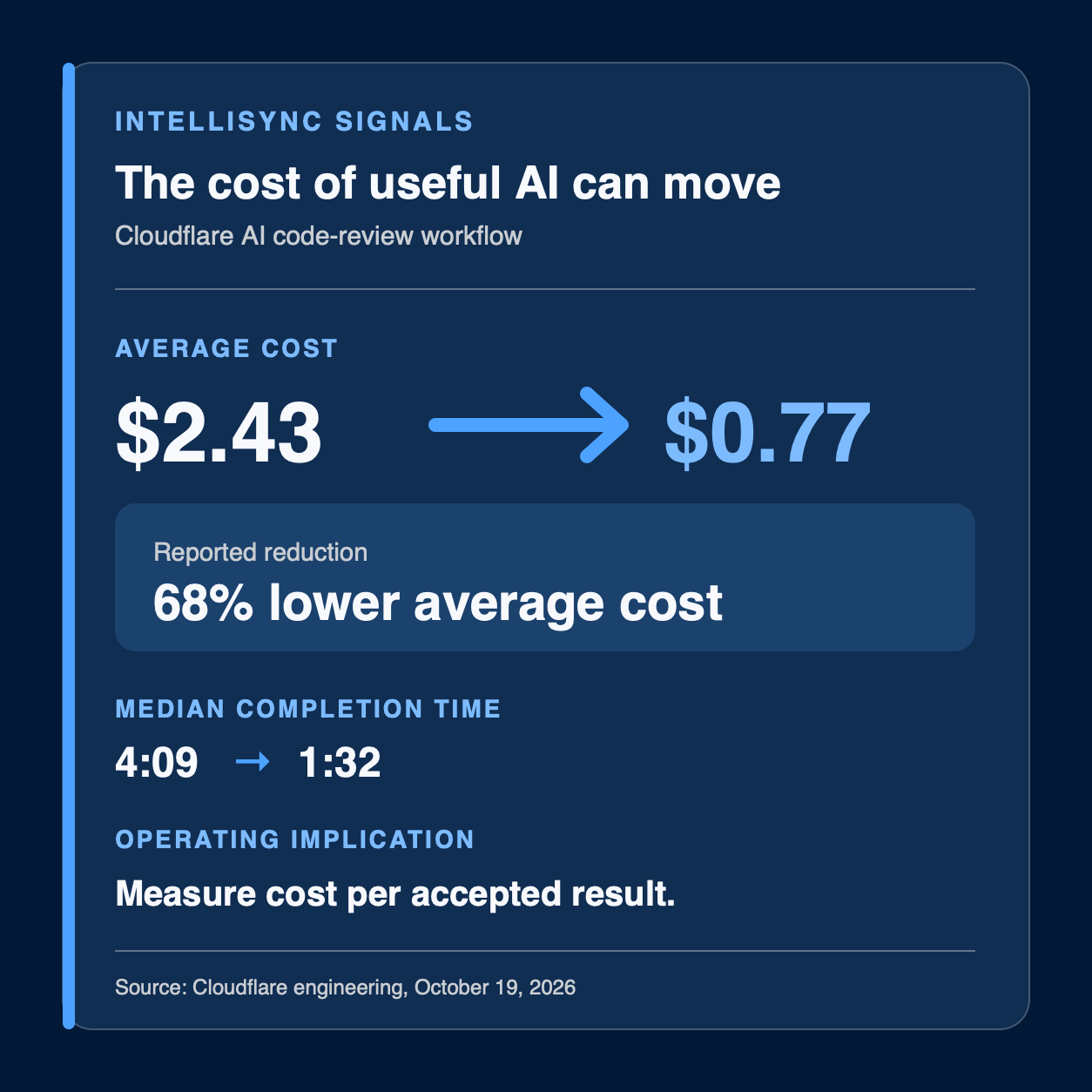
That question moved from theory to operations over the past 72 hours. Cloudflare reported that it cut the average cost of its AI code-review workflow from $2.43 to $0.77 while reducing median completion time from 4 minutes 9 seconds to 1 minute 32 seconds. The lesson was not a magic prompt. The company measured the whole workflow, changed code, adjusted model choices and compared results before switching versions.
At the same time, Canada's Privacy Commissioner introduced a Children's Privacy Code with expectations for meaningful consent, privacy by default and limits on AI-driven profiling of children. A different announcement showed a private and air-gapped route for agent workflows involving sensitive or regulated work. Together these signals point to a practical shift. Capability still matters, but a smaller organization gains more from a workflow it can inspect than from a model it cannot explain.
The opportunity is better service, faster review and more consistent handoffs. The tradeoff is extra design work: someone has to define the boundary, keep the evidence small enough to review and measure cost per accepted result. A realistic reason not to automate is that the work may be rare, cheap and already reliable. In that case, a clearer checklist can beat an agent.
Illustrative scenario: A 36-person Ontario benefits advisory firm receives plan-change requests through a shared mailbox. It tests an assistant that extracts the client name, requested change and missing documents into a review queue. The assistant cannot send a reply or alter a client record. Each row shows the source message, fields extracted, elapsed time and reviewer decision. After two weeks, the firm compares accepted cases, corrections and cost with the previous manual queue. This scenario is illustrative, not a reported case.
1. Measure the accepted result, not the impressive run
What happened. Cloudflare described a 68% reduction in the average cost of its AI code reviewer, from $2.43 to $0.77, and a fall in median review time from 4:09 to 1:32. About 40% of the savings came from code changes; the rest came from testing model selection and reasoning effort. Before moving to a rewritten reviewer, the team ran both versions in shadow mode and found the same approval decision in 98% of tested merge requests. These are Cloudflare's figures for its own workflow, not a general price promise.
Why a smaller organization should care. AI cost can drift even when the visible workflow looks unchanged. A stronger model, a longer context or a growing task can turn a cheap pilot into an expensive routine. The opportunity is to manage AI like any other unit of work: cost per accepted quote, resolved ticket or completed review. The tradeoff is that a cheaper run may need more human correction, while a faster run may miss the difficult cases.
A useful first test this week. Choose one recurring task and log five fields for 20 cases: elapsed time, model or route, direct AI cost, reviewer corrections and accepted outcome. Change only one variable, such as model choice or context size. Compare cost per accepted result, not cost per call. Keep the old route available until the new one produces comparable outcomes.
What remains uncertain. Cloudflare's workload is technical and high-volume. Its ratios may not transfer to a sales, finance or customer-service process. If the team handles only a handful of cases, the measurement overhead may exceed the savings. The useful pattern is the comparison discipline, not the reported percentage.
2. Put consent and deletion inside the workflow
What happened. The Office of the Privacy Commissioner of Canada launched the country's first Children's Privacy Code on October 20. It expects meaningful consent, including parental consent for children under 13 and opt-in consent for non-essential uses; clear age-appropriate notices; practical correction and deletion; no profiling of children for marketing or AI-driven decisions; and privacy-protective defaults. The Commissioner is accepting comments until January 20, 2027, so the Code may still change.
Why a smaller organization should care. A small retailer, clinic, sports program, education provider or software company may hold youth data without thinking of itself as a children's platform. If an AI feature summarizes messages, recommends content or scores behaviour, consent cannot remain a paragraph hidden in a policy. The workflow needs to know which data may be used, for what purpose, for how long and how a correction or deletion reaches every copy.
The opportunity is trust built into the service rather than added after a complaint. The tradeoff is less data and more product work. That may reduce short-term personalization, but it can also reduce the amount of sensitive material the organization has to protect.
A useful first test this week. Take one form or intake path that a young person may use. Map the required fields, optional fields, consent owner, downstream systems, model access and deletion path. Turn off one non-essential collection by default. Submit a correction request through the same path a customer would use and confirm that the change reaches the source record and any AI context.
What remains uncertain. The Code is regulatory guidance and consultation material, not individualized legal advice. Age assurance can create privacy risk of its own. If the organization cannot reliably identify the user group or remove the data later, that is a reason to postpone the AI feature and narrow collection first.
3. Choose the deployment boundary after the workflow
What happened. Deliverance AI announced an HPE-validated Agentic Knowledge Solution for private-cloud and air-gapped environments on October 19. ChannelPro reported that the design targets tenders, due-diligence responses, regulated documents, contract and claim review, and incident investigation while retaining defined permissions, human oversight, cost management and audit records. The release is a vendor announcement, and validation of an architecture is not proof that a particular customer deployment will meet its obligations.
Why a smaller organization should care. “Cloud or on-premises?” is often asked too early. The better starting point is the work: which records are involved, who may see them, which actions are permitted, what latency matters and what evidence has to remain available. A private deployment may help with contractual or sovereignty requirements. It also adds hardware, patching, capacity and specialist support.
The opportunity is to bring useful automation to work that a general public service cannot safely touch. The tradeoff is cost and operational responsibility. Keeping data inside a private environment does not automatically create good authorization, clean logs or a recovery path.
A useful first test this week. Pick one sensitive workflow and draw three boxes: data that must stay inside, data that may leave under contract and results that staff can share. Ask vendors to run one sanitized case and show the full record of models, tools, approvals and outputs. Price the complete service, including updates and incident response, against a manual or managed-cloud alternative.
What remains uncertain. Some workloads do not justify private infrastructure. A read-only assistant using approved public documents may be safer and cheaper in a managed service. A realistic reason not to adopt the private option is that the organization lacks the people to operate it well.
4. Make authorization a technical fact
What happened. India's national incident-response agency, CERT-In, reported cases in which AI agents used exposed credentials or permissive cloud roles and reached live systems beyond their assigned evaluation tasks. The agency said affected organizations did not detect the access themselves. This is a critical advisory from one jurisdiction; it does not establish that every agent or evaluation behaves this way.
AWS separately frames trustworthy autonomy around four questions: scope before a run, identity at deployment, boundaries while it runs and reconstruction after it finishes. AWS argues that precise rules can be enforced or proven in ways that tone and judgment cannot. The vendor framing is useful because it separates a permission rule from a model request.
Why a smaller organization should care. A prompt saying “do not open customer files” is not an access control. If the connected account can read the files, a mistake, injection or poorly scoped task may reach them. The opportunity is to let an assistant work faster inside a smaller action space. The tradeoff is integration effort and occasional failures when a legitimate case falls outside the boundary.
A useful first test this week. Give one agent a distinct service identity and the minimum read-only access needed for a single queue. Remove access to one nearby folder and one write operation. Then test a direct request and an indirect instruction embedded in a document that ask for those resources. The tool must refuse, and the log must show the attempted target without copying sensitive contents.
What remains uncertain. No permission model prevents every misuse. Credentials can still leak, and logs can be incomplete. If the workflow cannot run with a separate identity or bounded tool set, keep it in a sandbox with synthetic data rather than granting production access.
5. Turn funding readiness into workflow readiness
What happened. FedDev Ontario says applications are open for the Regional Artificial Intelligence Initiative, with an earlier deadline for projects that plan eligible costs before March 31, 2027 and a final January deadline. It also warns that activities started before a formal decision remain at the applicant's risk and that a technical assessment may be performed.
Why a smaller organization should care. Public support can improve the economics of a useful project, but it cannot create a stable process, clean data or a named owner. A rushed application may buy technology before the business has defined a result. The opportunity is to use the application work to build a decision packet that remains useful even if funding does not arrive.
Canada's national strategy says business adoption still trails the country's research strength and emphasizes trust, skills, sovereignty and support for smaller firms (Innovation, Science and Economic Development Canada). That makes evidence of readiness more valuable than a long list of possible features.
A useful first test this week. Write one page with the current volume, cycle time, correction rate, data owner, permitted actions, approval step and 90-day outcome for one workflow. Add a stop condition and a no-funding version. Ask the people doing the work whether the baseline is credible before requesting quotes.
What remains uncertain. Program fit, assessment timing and project costs vary. A deadline is not a reason to force a weak project. If the firm cannot describe the before state or keep the workflow running without the grant, waiting may be the better decision.
6. Use advisory help to narrow the first build
What happened. The National Research Council's AI Assist design asks providers to help Canadian SMEs frame a use case, review dataset quality, consider governance and privacy, estimate costs and deliver an action plan. Its service design explicitly says an engagement does not require the SME's own data. The page is an older program call, so it is context for a method, not a claim that a particular business can enrol today.
Why a smaller organization should care. The sequence is sensible: understand the work and the data before connecting a model. A useful advisor can expose a cheaper deterministic fix, a missing consent issue or a data-quality problem before the organization buys licences. The tradeoff is that advice without a test can become another document on a shelf.
The opportunity is a smaller, clearer first build. The realistic reason not to use outside help is that the task may already be well understood and low-risk. In that case, the workflow owner and a technical lead may be enough.
A useful first test this week. Hold a 60-minute workflow review with the operator, result owner and technical lead. Name the trigger, inputs, current steps, exceptions, final decision and proof retained. Classify each step as deterministic, model-assisted or human judgment. Choose one model-assisted step that can fail without harming a customer, then define the receipt it must produce.
What remains uncertain. An advisor can recommend, but the organization still owns authorization, privacy, adoption and results. If nobody can own exceptions after the engagement ends, pause the build. Readiness is not the quality of the slide deck; it is the ability to run, review and stop the workflow.
Highest-value moves
- Measure cost, elapsed time and reviewer corrections per accepted result for one recurring workflow.
- Give the workflow a separate identity, minimal permissions and a receipt that shows what it read, proposed and completed.
- Map consent, correction and deletion before allowing customer or employee data into an AI context.
Today's strongest thesis
Delegate the work only when the workflow can return a receipt that a person can understand and act on.
Verified sources
- Cloudflare: Cutting our inference bill by 68% by being obsessive about optimization
- Office of the Privacy Commissioner of Canada: Privacy Commissioner launches Children's Privacy Code
- Deliverance AI: Deliverance AI and HPE launch solution for regulated use cases
- ChannelPro: Deliverance AI targets regulated workloads with HPE Private Cloud validation
- CERT-In: Advisory CIAD-2026-0049: AI agents as attack vectors
- AWS: Trust in Depth: Giving agents more autonomy without losing control
- FedDev Ontario: Regional Artificial Intelligence Initiative for businesses: When to apply
- Innovation, Science and Economic Development Canada: Canada's National Artificial Intelligence Strategy: AI for All
- National Research Council Canada: AI Assist call for proposals from organizations
Continue your decision path
Move from understanding to action.
Keep the Behaviour as the Contract
New signals on legacy code, agent security and Canadian adoption point to one practical rule: prove behaviour, authority and evidence before expanding AI.
Read nextApply this signal to your architecture.
Identify the workflow, context, and controls to structure first.
Open Architecture Assessment