Operating question
As faster and cheaper AI multiplies work across screens, code and records, Canadian SMEs can gain safely by scaling acceptance rules, scoped identities and receipts before granting broader authority.
Agent Systems
Scale the Evidence Before the Authority
For
Leaders and workflow owners
You will leave with
4 operating decisions
Reading mode
11 min · 9 verified sources
Reading guide8 sections · Canadian briefing+
Highest-value moves
- 01Measure AI by cost per accepted result, including staff corrections and exception handling.
- 02Approve rules and held-back tests before output volume grows beyond practical review.
- 03Give each connected agent a named owner, scoped identity and tested revocation path.
- 04Define business measures and staged approvals before an agent coordinates cross-system action.
New model economics, agent identities, business-data controls and a disclosed isolation flaw point to one move: make proof grow before AI access does.
Today's strongest signal: AI agents can now reach more screens, records and code, so a smaller organization needs to make evidence scale before it expands access.
Picture a 35-person Ontario parts distributor. The finance lead sees an agent that can read invoices and enter details into accounting software. The outside developer can use another agent to modernize old code. The operations manager wants one assistant to answer questions across purchasing, inventory and service. Each idea could save time. Together, they create a new problem: output can grow much faster than a manager can inspect it.
The strongest releases from the preceding 72 hours make that shift concrete. IBM introduced cross-platform discovery, simulation and deterministic evaluation for agents, then made agent identity generally available with controls for short-lived credentials. Microsoft described how it is pairing agent-written code with tests and formal specifications. Oracle moved agents closer to finance, payroll, procurement and supply-chain actions while adding a layer that defines what business data means. Cloudflare disclosed a repaired tenant-isolation flaw in a long-context model service. The products differ, but the operating message is consistent: access, meaning and proof have to travel with the work.
For a Canadian SME, the opportunity is not to copy an enterprise control centre. It is to build a small receipt that survives higher volume: which account acted, what rule it used, which source supported the result, who approved the consequential step and how the team can reverse it. The tradeoff is setup time. More tests, scoped accounts and defined metrics can slow the first pilot. A realistic reason not to adopt a capability is that the current task is infrequent, the source data is unstable or the exception still needs expert judgment. In those cases, a better checklist may create more value than a faster model.
Illustrative scenario: The distributor tests invoice entry on 60 sanitized invoices. The model may read approved folders and prepare draft entries, but it cannot post a payment or change a supplier record. The team holds back 12 cases from setup, including a duplicate invoice, a handwritten tax adjustment and a new bank account. It records field accuracy, corrections, elapsed time and cost per accepted draft. The model handles standard invoices well, but the bank-change case triggers a manual supplier callback. The team expands only the standard path and keeps the exception queue human-owned. This scenario is illustrative, not a reported case.
1. Compare the agent on your own cases
What happened. IBM announced new watsonx Orchestrate capabilities for discovering and managing agents built on several platforms. The release includes simulated user journeys, deterministic checks of tool calls and parameters, execution traces and business-defined evaluation criteria. Some management functions are generally available, while discovery and containment remain technology previews. These are IBM product claims, not independent proof that one platform can evaluate every business workflow.
Why a smaller organization should care. Teams can now choose among agents from several vendors, but a benchmark or polished demo rarely represents local documents, permissions and exceptions. The opportunity is to compare tools on the same job before connecting one to live systems. The tradeoff is evaluation work, and an automated judge can repeat the same blind spot as the agent it scores.
A useful first test this week. Build ten cases for one repetitive, reversible task: six ordinary, two incomplete, one unauthorized and one deliberately ambiguous. Run every candidate tool with the same inputs and permissions. Score the accepted result, source use, tool calls, corrections, elapsed time and cost. Keep the winner read-only or draft-only until the held-back cases show that the exception path works.
What remains uncertain. Cross-platform management can add another system without eliminating vendor differences. A simulated user may not reproduce the way a busy employee phrases a request. If the workflow is low-volume or already dependable, an import template or a better checklist may remain the cheaper and clearer option.
2. Approve the rule before the output multiplies
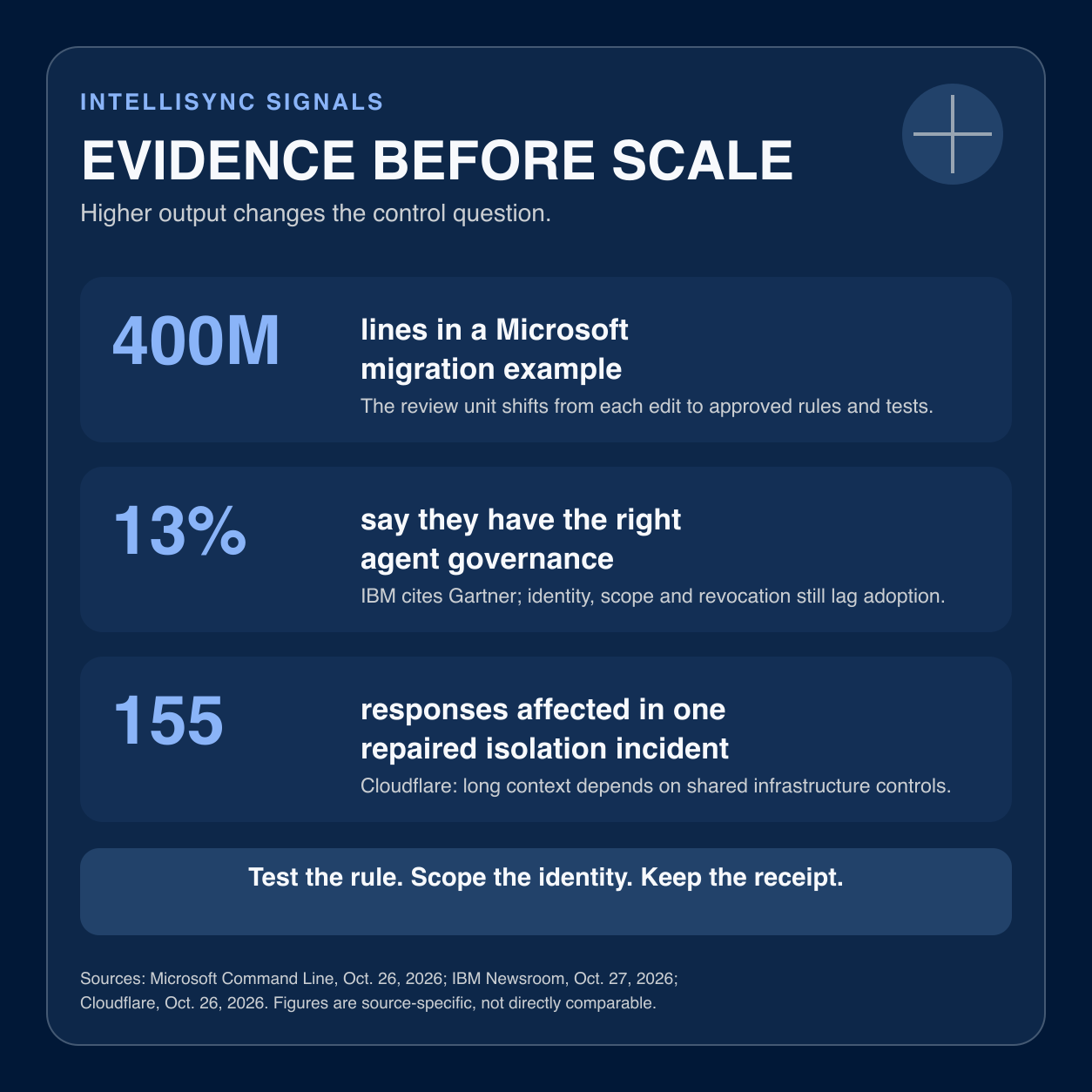
What happened. Microsoft described using AI agents with static analysis, testing and formal verification for large code modernization. Its examples include moving a 400-million-line codebase to a new compiler toolchain. Rather than asking people to review every generated edit, a small expert group approves a knowledge base, tests behaviour feature by feature and uses specifications to check important properties. Microsoft is describing its own engineering work, and it leaves open whether an AI-inferred specification represents what the system ought to do.
Why a smaller organization should care. The same pattern applies outside software. A team cannot sensibly reread every classified message, extracted invoice or suggested schedule when volume rises. It can approve the decision rule, sample hard cases and measure the result against a known baseline. The opportunity is focused human attention. The tradeoff is that a wrong rule can spread consistently.
A useful first test this week. Write five acceptance rules for one workflow in plain language. For invoice entry, they might cover supplier match, duplicate detection, tax treatment, account code and approval limit. Keep 20% of cases hidden during setup. Run the tool, compare those cases with the current process and require a person to explain every failed rule before changing the prompt or model.
What remains uncertain. Formal methods are specialized and may be excessive for routine office work. Even a precise specification can preserve an old process that no longer serves customers. If the team cannot agree on the rule or the expected result, automation is not ready; the useful work is resolving that disagreement.
3. Give each agent an account you can revoke
What happened. IBM made Agent Identity generally available, with an inventory of agent owners, lifecycle state, approved tool connections and delegated authority. IBM's TechXchange announcement adds short-lived credentials, least-privilege access, real-time revocation and cross-platform agent discovery. That announcement cites Gartner research saying only 13% of organizations believe they have the right agent governance. The figure is IBM's presentation of Gartner research, not a Canadian SME benchmark. The products target enterprise environments, and availability or integration depth can vary.
Why a smaller organization should care. A shared service account hides who authorized an action and makes offboarding harder. Giving an agent its own account can limit it to one folder, one customer queue or one draft action. The opportunity is a clear audit trail and a usable off switch. The tradeoff is another identity to own, review and retire.
A useful first test this week. Inventory one active assistant. Record its human owner, exact job, data sources, tools, credential lifetime, permitted actions and shutdown step. Replace any shared password with a scoped account or token if the system supports it. Ask a second person to revoke the account and confirm that queued and new work both stop without disabling the underlying business application.
What remains uncertain. A named identity does not prove that the agent's decision was correct or that copied data disappeared after revocation. Smaller software products may not support short-lived credentials or separate service identities. If the only option is a broad owner account, do not connect the assistant to consequential actions.
4. Separate the objective from permission to execute
What happened. Oracle announced agentic applications that can coordinate work across finance, payroll, procurement, supply chain, service and other business systems. Users can state an objective, while the software selects transactions, workflows and agents; Oracle says approved actions remain subject to organizational policies and controls. This is a vendor announcement for Oracle customers, not evidence that every listed application improves outcomes in every setting.
Why a smaller organization should care. Business software is moving from recommending a next step to arranging several steps. That may reduce handoffs in purchasing or service. It also makes a broad request such as "fix late orders" dangerous if the system can change allocations, contact customers or update records without clear limits. The opportunity is coordinated work. The tradeoff is that convenience can hide which decision was made where.
A useful first test this week. Take one objective and split it into propose, approve and execute. Let the assistant propose a plan using current records. Require the plan to name each intended write, the affected customer or account, the approval owner and the rollback method. Approve only one low-risk action manually. Compare the promised outcome with the actual business result before widening authority.
What remains uncertain. A product's control language may not match a smaller organization's informal approvals. Cross-system work can fail halfway and leave records inconsistent. If the team cannot reverse a partial action or identify the owner of each step, a coordinated agent is premature.
5. Define what the numbers mean before the agent uses them
What happened. Oracle also announced a business semantic layer for its Autonomous AI Lakehouse. A semantic layer is a shared definition of measures, dimensions and business terms, such as whether revenue means invoiced, shipped or collected revenue. Oracle says some catalog and semantic capabilities are planned within the next 12 months, while other data and control features are available now.
Why a smaller organization should care. An assistant can query several systems and still give the wrong answer if purchasing, sales and finance use the same word differently. The opportunity is to answer recurring questions from a shared definition instead of rebuilding a spreadsheet each time. The tradeoff is the hard human work of agreeing on ownership and definitions.
A useful first test this week. Pick one disputed measure, such as on-time delivery or gross margin. Write its formula, source fields, exclusions, refresh time and owner on one page. Ask two people to calculate it independently from the same sample. Only after the results match should an AI tool use that measure in a recommendation. Keep the definition beside the output so a reader can inspect it.
What remains uncertain. A semantic layer can make an incorrect definition consistent. Planned vendor features may change before release. If a metric is used only once or the underlying records are incomplete, a reviewed spreadsheet may be more dependable than a new data platform.
6. Treat long context as shared infrastructure
What happened. Cloudflare disclosed and repaired a tenant-isolation issue in one Workers AI model. Between August 27 and September 9, 155 responses contained data from other customers' prior requests; all involved prompts longer than 681,280 tokens. Cloudflare says it found no evidence of deliberate exploitation, took the model offline after reproducing the report, aligned memory capacity with the advertised context window and added rejection checks. No other hosted model was affected.
Why a smaller organization should care. A long prompt often looks like a private folder placed into a model. In a hosted service, it also depends on shared memory, scheduling and isolation code. The opportunity is to analyze a large contract set or project record at once. The tradeoff is a larger sensitive payload and fewer obvious boundaries inside the request.
A useful first test this week. Classify the data before sending it. Use synthetic or redacted material for the first long-context test, set the smallest useful document set and record the provider, region, retention setting and deletion path. Canada's digital regulators reported that workshop participants tied responsible AI adoption to privacy by design, human oversight and real-world testing. A small business can borrow those checks without copying a regulatory program.
What remains uncertain. This incident involved one model configuration and an open-source inference engine; it does not show that every hosted model leaks data. Provider reports also cannot replace a customer's own data classification. If the documents include highly sensitive client, employee or legal information, a smaller input or an approved private environment may be the better choice.
Highest-value moves
- Measure one pilot by cost per accepted result, including corrections and exceptions, before expanding volume.
- Give every connected assistant a named owner, scoped account and tested revocation path.
- Define one business rule or metric in plain language, then hold back cases to test whether the evidence scales with the output.
FedDev Ontario is accepting Regional Artificial Intelligence Initiative applications and sets November 24, 2026 as the early deadline for eligible projects beginning before March 31, 2027. Funding may help with the work, but it does not replace the evidence.
Today's strongest thesis
Scale the evidence before you scale the authority.
Verified sources
- IBM watsonx Orchestrate: IBM watsonx Orchestrate advances enterprise AI agent management
- Microsoft: Cheap code, precious trust: Code modernization at scale
- IBM: IBM Agent Identity is now generally available
- IBM Newsroom: IBM introduces identity and control for AI agents
- Oracle: Oracle advances outcome-driven AI across Fusion Applications
- Oracle Database: Oracle advances Autonomous AI Lakehouse with a business semantic layer
- Cloudflare: Cross-request KV cache exposure in the GLM-5.3 Workers AI model
- Competition Bureau Canada: What We Heard Report: Canadian Digital Regulators Forum Workshop on the Impact of Artificial Intelligence on Regulatory Mandates
- FedDev Ontario: Regional Artificial Intelligence Initiative for businesses: When to apply
Continue your decision path
Move from understanding to action.
Daily Signal: Give every agent an independent record
Seven practical signals for Canadian operators: stronger models, cheaper routing, persistent agents, independent evidence, containment, cost ownership, and correlated risk.
Read nextApply this signal to your architecture.
Identify the workflow, context, and controls to structure first.
Open Architecture Assessment