Operating question
As model cost and latency fall, Canadian SMEs can create more value by routing work by consequence, measuring accepted results and keeping access, freshness and exceptions explicit.
Decision Architecture
The Bottleneck Moved Beyond the Model
For
Leaders and workflow owners
You will leave with
4 operating decisions
Reading mode
12 min · 10 verified sources
Reading guide9 sections · Canadian briefing+
Highest-value moves
- 01Measure cost per accepted result instead of comparing token prices alone.
- 02Map task outcomes and consequences before making claims about changing whole jobs.
- 03Treat every connected app as a new authorization path with a tested off switch.
- 04Use caching, retrieval and physical AI only where freshness, evidence and fallback are visible.
Cheaper models, connected apps, cached context and physical AI point to one practical move: measure the workflow and its permissions, not just the model.
Today's strongest signal: cheaper, faster AI makes workflow judgment—not model access—the scarce resource for a small business deciding what to automate.
A 40-person Ontario distributor can now afford to test an AI assistant on invoices, customer questions or product records without treating every request like a major software project. That is useful. It also makes a weak process easier to repeat. If the source data is unclear, the approval step is informal or nobody owns the exception, lower model prices simply let the problem travel farther and faster.
The strongest developments from the preceding 72 hours all move capability closer to ordinary work. OpenAI released a less expensive computer-use model and new data about the tasks people bring to ChatGPT. OpenAI and Oracle described tighter links between AI and business applications. AWS published practical patterns for caching repeated context and for observing agent-led retrieval. Canadian digital regulators emphasized testing, privacy and human oversight. Google moved embodied reasoning for robots into public preview and described a NASA proof of concept. The products differ, but the business question is the same: what part of the workflow is ready for more speed, and what part still needs a person, a rule or better evidence?
The opportunity is to redesign one bounded job around an accepted result. The tradeoff is that savings on tokens or minutes do not remove setup, integration, review, training or exception costs. A realistic reason not to adopt a new capability is that the task happens rarely, the inputs change too often, the error is costly or the current checklist already works. In that case, waiting is an operating choice, not a failure of ambition.
Illustrative scenario: A regional HVAC company receives equipment photos, serial numbers and service notes from technicians. It tests a visual model on 50 closed work orders. The model may match a photo to the approved product catalogue and draft the parts list, but it cannot order parts or change a customer record. Ten cases are held back, including a blurry plate, a discontinued unit and two models with similar housings. The team measures accepted lists, corrections, elapsed time and cost. Standard units improve; the ambiguous models remain in a human queue. The scenario is illustrative, not a reported case.
1. Route work by outcome, not by the newest model
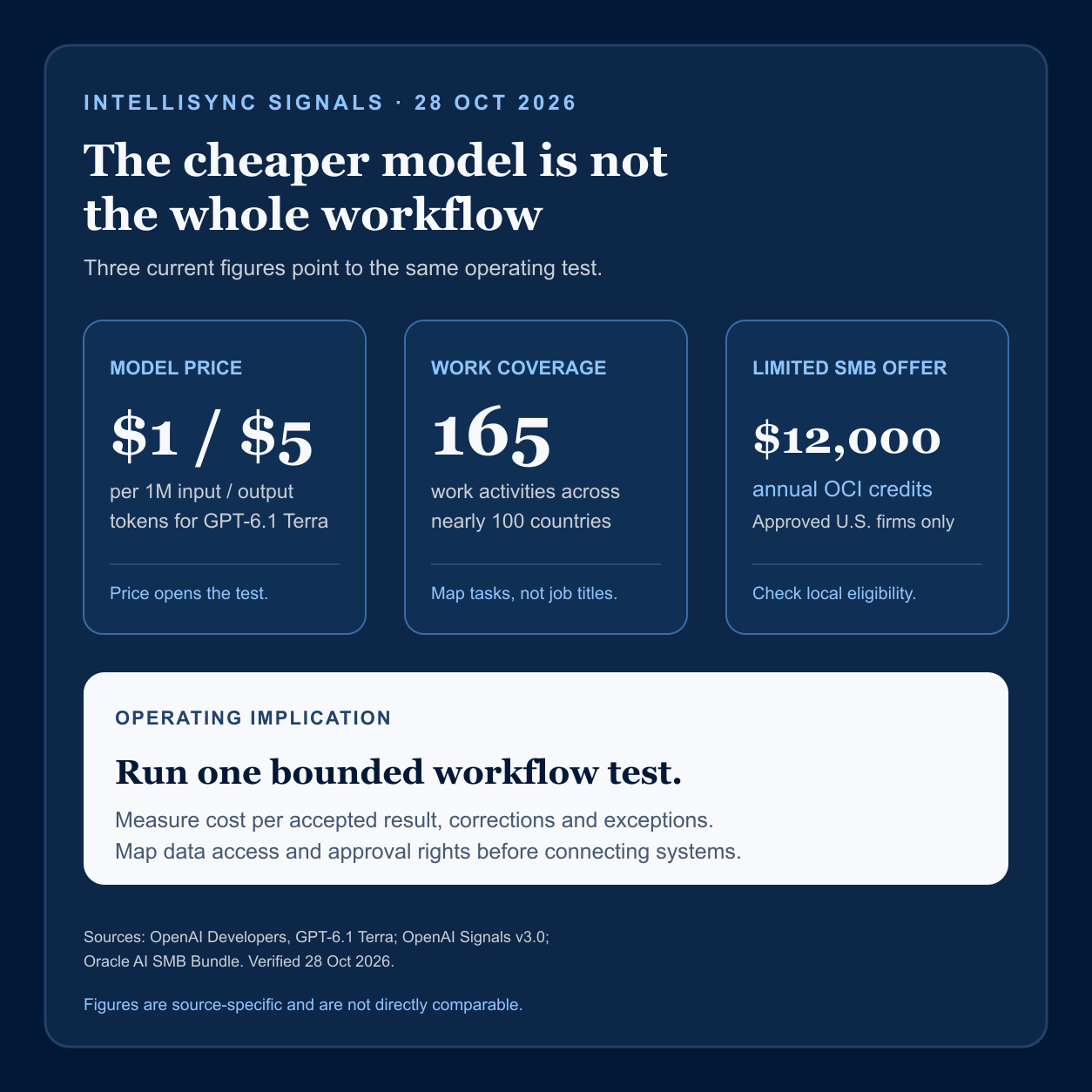
What happened. OpenAI's model documentation describes GPT-6.1 Terra as a fast, efficient model for visual reasoning, writing and computer use. Standard API pricing is $1 per million input tokens and $5 per million output tokens, with cached input priced at $0.05 per million. The documentation directs teams to use the Responses API for tool calling and to test the model on the work they intend to run. The accompanying safety addendum classifies Terra at the Critical threshold for cybersecurity capability and says it uses the same safeguards stack as the larger models.
Why a smaller organization should care. Lower price and latency make visual, form-filling and screen-based work practical at higher volume. The opportunity is to send routine cases to an efficient model and reserve a stronger model or a person for ambiguity. The tradeoff is routing complexity. A cheap first pass that creates corrections, retries or unsafe tool calls can cost more than one careful pass.
A useful first test this week. Select 30 completed cases from one reversible workflow. Run the same inputs through the current route and the candidate route. Record accepted results, staff corrections, time, model usage and failures. Set one rule for escalation, such as missing evidence, a low-confidence match or any request to write to a live system.
What remains uncertain. Vendor benchmarks do not reproduce your documents, permissions or staff habits. The model is also newly released, so availability and performance can vary by product and region. Do not adopt it only because the per-token price is lower; adopt it if the cost per accepted result is better.
2. Measure tasks before declaring that a job has changed
What happened. OpenAI released its Signals v3.0 data and methodology as downloadable CSV files, covering 165 work activities across nearly 100 countries. The quarterly data spans the first quarter of 2025 through the third quarter of 2026 and maps usage to intermediate work activities such as preparing instructional material, creating marketing content, programming and analyzing business data. It describes what people bring to ChatGPT; it does not prove that the work was correct, adopted by an employer or completed without review.
Why a smaller organization should care. Job titles hide the useful unit of change. One bookkeeper may reconcile accounts, chase documents, explain variances and prepare reports. AI may help with two activities and add risk to another. Task-level mapping lets an owner find a narrow gain without making a broad claim about replacing a role. The tradeoff is measurement effort and the possibility that the team optimizes an easy task while leaving the real bottleneck alone.
A useful first test this week. Ask one workflow owner to list the ten activities that make up a recurring process. Mark the time spent, the source of truth, the consequence of an error and the person who accepts the result. Choose one frequent, low-consequence activity with stable inputs. Compare the baseline with a two-week assisted trial.
What remains uncertain. Consumer usage across countries is not a benchmark for a Canadian SME, and activity categories can blur local differences. A task may be technically automatable but still depend on trust, customer context or tacit knowledge. If mapping reveals that the time is mostly waiting for approvals or missing data, fix that before buying another model.
3. Connected apps turn convenience into an access decision
What happened. Oracle announced a collaboration that brings ChatGPT, Codex and OpenAI models together with Oracle applications, data and infrastructure. Oracle AI Workspace is designed to let people complete approved work through business systems while keeping permissions, controls and accountability in place. The new Oracle AI SMB Bundle offers approved U.S. small businesses $12,000 in annual Oracle Cloud credits, renewable for up to two additional years, along with limited product benefits. Each component has separate access rights, limits and terms.
Why a smaller organization should care. The interface is becoming less important than the access behind it. One assistant can see finance, purchasing, calendars or mail, which may remove copying and searching. It can also combine information that was separated for a reason. The tradeoff is a larger permission surface and more reliance on vendor availability. A realistic reason to wait is that the team cannot yet distinguish business accounts from personal accounts or define which records are off limits.
A useful first test this week. Draw a one-page access map for one proposed connection. List the account, data types, read actions, write actions, approver, logs and off switch. Start with one business-owned read-only source. Use synthetic or non-sensitive cases until revocation and audit history have been tested.
What remains uncertain. The workspace and bundle describe intended or limited-availability products, not your configured controls. The bundle is restricted to approved U.S. businesses and is not a Canadian funding offer. Availability, price and integration depth can change. Treat every connector as a new authorization path, not as a harmless convenience setting.
4. Cache stable context, but give freshness an expiry time
What happened. AWS published prompt-caching patterns for OpenAI models on Amazon Bedrock. Prompt caching reuses repeated instructions, tools and history instead of processing the same input on every agent step. That can reduce input cost and latency. It also creates a design question: which context is stable enough to reuse, for how long, and what event must invalidate it?
Why a smaller organization should care. Many business workflows repeat the same policy, catalogue or form instructions. Caching can make a busy assistant faster and more economical without changing the model. The tradeoff is stale context. A cached price list, approval limit or safety instruction can outlive the decision that changed it. If the workflow changes infrequently or its context is small, adding cache logic may cost more to operate than it saves.
A useful first test this week. Separate one prompt into stable and live parts. Stable may include formatting rules and approved tool descriptions. Live may include inventory, customer status and current limits. Assign an owner and expiry to the stable block, then test a known policy change to confirm the cache is replaced before the next result is accepted.
What remains uncertain. Savings depend on repetition, model support, cache-hit rates and retention settings. A demonstration with long agent context may overstate value for a short office workflow. Measure end-to-end time and accepted-result cost; do not report a cache discount as a business outcome.
5. More capable retrieval requires more visible evidence
What happened. AWS published an agentic retrieval design that routes across two managed knowledge bases, returns cited answers and provisions seven layers of telemetry plus on-demand and continuous evaluation. Agentic retrieval means a model can decide where to search, retrieve more than once and refine before answering. AWS also notes the opposite case plainly: a single index and one retrieval remain simpler and sufficient when one corpus holds the answer.
Why a smaller organization should care. A service team may need policy, product and customer sources to answer one question. Routing can reduce irrelevant search and make citations easier to inspect. The tradeoff is that every extra decision adds cost, latency and another failure path. Observability—the records that show what the system did—becomes part of the feature, not an optional dashboard.
A useful first test this week. Build 20 questions with known answers: some from one source, some requiring two sources and some that should return no answer. Record the source selected, passages retrieved, citation accuracy, response time and cost. Require the system to say when evidence is insufficient.
What remains uncertain. A managed service reduces infrastructure work but can narrow portability and data-location choices. Continuous evaluation can also create its own model cost. If one approved folder answers the current question, conventional search may be safer, cheaper and easier to explain.
6. Canadian guidance is converging on proportionate proof
What happened. The Canadian Digital Regulators Forum published a report on AI's impact across competition, privacy, broadcasting and copyright mandates. Participants described uses in research, customer engagement, communications and large-volume information processing, while emphasizing privacy by design, human oversight, real-world testing and safeguards proportionate to risk. The report records a workshop; it is not a new law or a compliance checklist.
Why a smaller organization should care. The language fits practical adoption. A low-risk draft does not need the same control as a decision about credit, employment or a customer account. The opportunity is to scale review with consequence instead of blocking every experiment. The tradeoff is that someone must classify the consequence honestly. Calling a customer-facing action a draft does not make it harmless if staff usually accept it without reading.
A useful first test this week. Label the steps in one workflow as read, recommend, prepare, approve and execute. Assign a person to the last two. Define which data may enter each step, what evidence must remain with the result and what event stops the test. Keep any consequential write behind explicit approval.
What remains uncertain. Canadian requirements continue to evolve, and sector obligations can be stricter than a general workshop discussion. Legal advice may be necessary for regulated decisions or sensitive information. If the team cannot explain the data source, affected person and appeal path, the capability is not ready for that decision.
7. Physical AI raises the cost of a bad assumption
What happened. Google Cloud made Gemini Robotics Embodied Reasoning 2 available in public preview, describing long-horizon planning, video understanding, hardware interfaces and built-in safety guardrails. Google Cloud and NASA also described proof-of-concept robotic assistants for future Moon and Mars missions, including edge-computing tests for logistics and emergency tool retrieval. These are frontier and proof-of-concept settings, not evidence that a small manufacturer can safely deploy the same pattern tomorrow.
Why a smaller organization should care. The near-term lesson is not to buy a humanoid. It is that AI is moving from advice to physical action, where latency, connectivity, equipment limits and safe fallback matter. A camera-guided inspection or parts-picking aid may become useful sooner than general-purpose robotics. The tradeoff includes integration, maintenance, worker training and physical safety.
A useful first test this week. Choose a simulation or shadow-mode task: identify a part, flag an unsafe placement or suggest the next pick without moving equipment. Compare the recommendation with a trained worker. Record false positives, missed hazards, response time and what happens when the network fails.
What remains uncertain. Public preview availability, supported hardware and real-world performance can change. A model that plans well in a demonstration may fail under glare, dust, damaged labels or unusual layouts. If the business case depends on autonomous movement before the shadow test is reliable, the project is too early.
Highest-value moves
- Pick one frequent, reversible task and measure cost per accepted result, including corrections and exceptions.
- Map every connected account, data type, write right, approver and off switch before enabling a connector.
- Keep a held-back test set and a human-owned exception queue as volume grows.
Today's strongest thesis
Cheaper intelligence creates value only when the workflow knows what to accept, what to escalate and who can stop it.
Verified sources
- OpenAI Developers: GPT-6.1 Terra Model
- OpenAI Deployment Safety Hub: Addendum to GPT-6 Astra System Card: GPT-6.1 Terra
- OpenAI Economic Research: OpenAI Signals v3.0 data download
- Oracle: Oracle Reinvents Enterprise Computing for the AI Era with OpenAI
- Oracle for SMBs: Oracle AI SMB Bundle
- AWS Machine Learning Blog: Groundhog Day for AI agents: Prompt caching patterns for using OpenAI models on Amazon Bedrock
- AWS Bedrock: Build agentic retrieval on a Managed Amazon Bedrock Knowledge Base with CDK
- Competition Bureau Canada: What We Heard Report: Canadian Digital Regulators Forum Workshop on the Impact of Artificial Intelligence on Regulatory Mandates
- Google Cloud AI: Gemini Robotics Embodied Reasoning 2 is now available on Google Cloud
- Google Cloud Public Sector: Google Cloud and NASA: Testing robotic systems for deep space missions
Continue your decision path
Move from understanding to action.
Daily Signal: Make accepted work grow faster than the queue
Seven practical signals for Canadian operators: accepted findings, deterministic tool checks, narrow permissions, drift benchmarks, agent ownership, voice consent, and funding readiness.
Read nextApply this signal to your architecture.
Identify the workflow, context, and controls to structure first.
Open Architecture Assessment