Operating question
As AI work accelerates, dependable value comes from explicit data rules, bounded evaluations, selective human decisions, attributable identities and evidence tied to the business result.
Decision Architecture
Speed Is Not the Operating Result
For
Leaders and workflow owners
You will leave with
4 operating decisions
Reading mode
10 min · 11 verified sources
Reading guide9 sections · Canadian briefing+
Highest-value moves
- 01Bring questions to governed records before creating another uncontrolled copy.
- 02Use fixed tests and explicit uncertainty for narrow, repeatable quality decisions.
- 03Reserve human attention for consequential changes and exceptions.
- 04Measure customer and operating results beside speed, tokens and uptime.
AI can accelerate code and decisions. Canadian SMEs still need governed data, fixed tests, selective approvals, distinct identities and business-outcome proof.
Today's strongest signal: faster AI work is no longer the scarce part. The scarce part is deciding which data an agent may use, which result is good enough, when a person must step in, and whether the business outcome improved.
Picture a 60-person Ontario service company. Its operations lead wants an agent to diagnose delayed jobs. The records sit in a scheduling app, a shared drive, an accounting system and technicians' notes. A polished demo can summarize all four. Production is harder. The team must decide which record wins when dates conflict, whether the agent may contact a customer, what evidence makes a diagnosis acceptable and who can stop the workflow. Speed helps only after those decisions become explicit.
The strongest releases from the preceding 72 hours point in the same direction. Google is bringing governed context to data that stays across clouds. AWS is turning fixed-choice evaluations and selective approvals into product features. Honeycomb is moving agent checks toward production traces. Google is giving agents distinct credentials rather than shared long-lived keys. Canadian programmes are asking applicants to show data, governance, security and measurable outcomes, not only a clever model.
The opportunity for a smaller organization is real: reuse the workflow and records it already trusts, add AI where judgment or messy language slows the work, and preserve a person at the consequential step. The tradeoff is extra design and measurement before scale. A realistic reason not to adopt is that a low-volume workflow with stable rules may remain cheaper and clearer as ordinary automation.
Illustrative scenario: the service company gives an internal agent read-only access to job status and approved notes. The agent may propose the cause of a delay and draft a customer update, but only a dispatcher can send it. Ten known cases become a fixed evaluation set. A dashboard compares diagnosis accuracy, time to resolution and reopened jobs. If the source records conflict, the agent returns the conflict instead of choosing. This scenario is illustrative, not a reported deployment.
1. Bring the question to governed data before copying everything
What happened. On November 4, Google announced new Agentic Data Cloud capabilities that let agents query data across clouds, reuse governed context and submit proposed context enrichment for human review, versioning and rollback. Google reports internal benchmarks of nearly four times higher agent accuracy, up to 33% lower latency and up to 75% fewer tokens with its Knowledge Catalog. Those are provider benchmarks, not independent results.
Why a smaller organization should care. Many firms do not have one clean warehouse. Customer truth is split across accounting, CRM, files and a line-of-business tool. Copying everything into a new AI store creates another system to secure, reconcile and pay for. Querying records in place may reduce duplication, but only if access, definitions and freshness travel with the request.
A useful first test this week. Choose one question that currently needs two systems, such as "Which delayed jobs have unpaid deposits?" Write the source of each field, the allowed join, the refresh time and the conflict rule. Compare ten answers with the original records and record the data read, tokens used and elapsed time.
What remains uncertain. Google's claims come from its own platform and enterprise stack. Cross-cloud access can add latency, fees and new trust relationships. If two exports and a spreadsheet already answer the question safely each month, a federated agent layer may be unnecessary.
2. Give fast experiments their own bounded workspace
What happened. Google previewed AlloyDB Express, which can give a developer or coding agent an isolated PostgreSQL database that pauses when idle while central identity and network rules still apply. Separately, AWS added managed migration from Hive tables to Apache Iceberg, an open table format, with start, sync and complete steps while production workloads continue.
Why a smaller organization should care. AI can create prototypes faster than a team can safely provision test data or unwind a platform choice. Isolation limits the blast radius of a bad query. An open data format and staged cutover can preserve an exit path. Neither feature removes the need to classify data or test recovery, but both make those controls easier to express.
A useful first test this week. Create a temporary environment with synthetic or masked data for one agent-built feature. Deny public access, use a separate service identity and set an expiry. Export the result in a portable format, restore it elsewhere and confirm that the old environment can be removed without losing the decision record.
What remains uncertain. AlloyDB Express is in preview, and the AWS migration supports specific formats, regions and account arrangements. A small firm may not need a lakehouse or a new managed database. The useful pattern is smaller: isolate experiments, make expiry automatic and prove portability before production data arrives.
3. Use fixed decisions for narrow checks
What happened. AWS published a method for using decision models with AgentCore Evaluations. A decision model receives structured state and a fixed set of allowed answers, then returns probabilities rather than an open-ended explanation. AWS positions this as a screening layer for questions such as whether a response stayed on policy or a tool call is safe to approve.
Why a smaller organization should care. Teams often use a large model to judge another model because it is convenient. That can be slow, costly and inconsistent for simple checks. Some decisions are closer to quality control: correct category, allowed destination, required citation present, approval still valid. A fixed answer and threshold are easier to test and audit.
A useful first test this week. Take 100 past cases for one yes-or-no check. Have two people label them and resolve disagreements. Compare a deterministic rule, a small decision model and the current review process on false approvals, false blocks, cost and speed. Route uncertain cases to a person.
What remains uncertain. A probability is not proof, and thresholds can hide unequal errors across customers or cases. Fixed-choice models are a poor fit for novel, legal or reputational judgment. Use them to narrow a queue, not to manufacture certainty.
4. Protect human attention for the consequential step
What happened. AWS described Smart Approvals in Amazon Quick, which evaluates eligible actions against the user's request and either allows them within existing controls or returns them for review. AWS says the feature does not grant extra permissions or remove approvals that policy already requires.
Why a smaller organization should care. Asking a person to approve every lookup feels safe until the prompts become background noise. The opposite extreme—letting the agent approve itself—removes meaningful control. A useful approval sits where money moves, a customer is contacted, a record changes or evidence is incomplete.
A useful first test this week. Map one workflow into read, draft, reversible write and consequential write. Let reads and drafts proceed under logs. Require a person for the consequential step and for any exception. Measure approval count, wait time, overrides and mistakes for two weeks before changing the boundary.
What remains uncertain. Risk scoring can be wrong, and reducing prompts can create false comfort. A low-volume team may prefer explicit review because the added delay is small. Safety, authorization, publication, financial and external communication gates remain firm even when a vendor offers automated approval.
5. Let production evidence catch up with delivery speed
What happened. On November 3, Honeycomb announced AI site-reliability agents that use traces and deployment evidence to investigate regressions and show the work behind a finding. Honeycomb reports that 76% of respondents to a forthcoming survey said AI-generated code grew faster than their ability to review and monitor it; 65% reported a production issue in the prior six months involving AI rate limits, runaway loops or token-spend spikes. These are vendor-reported survey figures, not a universal benchmark.
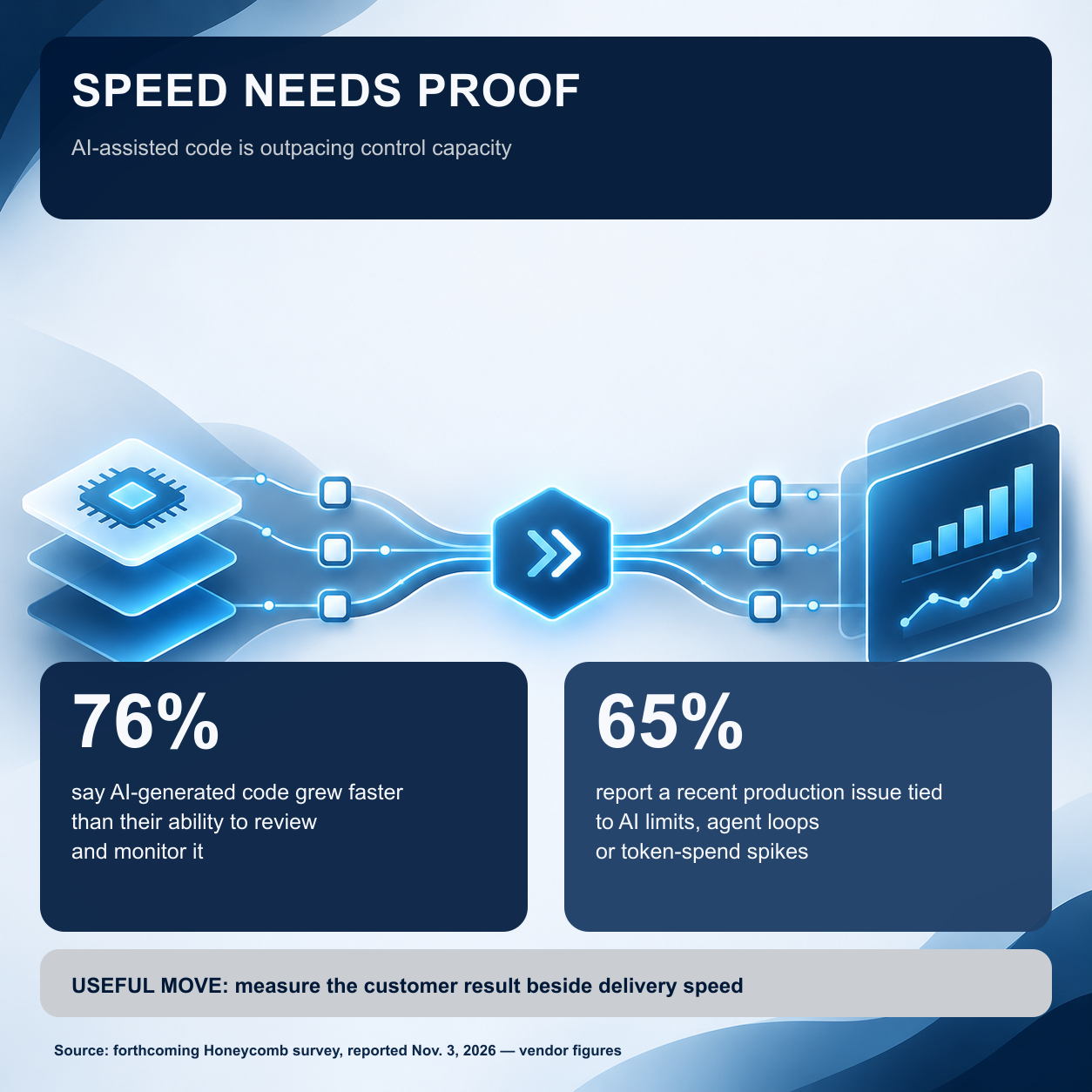
Why a smaller organization should care. A small team can ship more code without gaining more review hours. Traditional uptime may stay green while an agent repeats a tool call, spends too much or returns a plausible but wrong customer answer. The operating result appears in completed orders, resolved tickets, clean invoices and customers who do not need to call back.
A useful first test this week. For one AI-assisted workflow, connect each run to a trace identifier, deployment version, cost and business outcome. Review ten failures from the customer's perspective. Add a stop rule for repeated calls, missing outcome evidence and a spending spike.
What remains uncertain. Honeycomb's survey is forthcoming and its product claims need testing in each environment. More telemetry can create cost and noise. If the workflow only drafts internal text, a simple error log and weekly sample may be proportionate.
6. Give the agent an identity, then keep the change point human
What happened. Google's November 4 security release introduced vault-managed delegated credentials and preview agent OIDC tokens so agents can authenticate across systems without static long-lived keys. An AWS case study on U Mobile describes a live support workflow that investigates across several systems but asks a person to confirm before changing a subscriber account.
Why a smaller organization should care. Shared keys make it hard to tell whether a person, script or agent changed a record. A distinct identity supports least privilege, cancellation and an audit trail. Keeping a person at the change point separates useful investigation from authority over a live customer.
A useful first test this week. Replace one shared integration key with a dedicated agent identity. Grant only the records and actions needed for one task, set an expiry and log the human request beside each tool call. Revoke the identity and confirm the core service continues through a manual path.
What remains uncertain. Identity products add setup and may not work across older systems. A dedicated service account can still be over-privileged. The U Mobile figures and architecture are vendor case-study evidence, not a promise that the same result will travel to a Canadian SME.
7. Make evidence part of the Canadian investment case
What happened. Canada's expanded Regional Artificial Intelligence Initiative reports 218 supported projects, more than 1,100 jobs created or maintained and about $1.77 leveraged for each approved dollar. A current federal challenge on AI traceability asks for open interfaces, versioned requirements, reassessment, access control and human oversight. FedDev Ontario's adoption stream lists repayable support from $125,000 to $5 million, up to 50% of eligible costs, and explicitly includes data quality, governance, cybersecurity and process redesign.
Why a smaller organization should care. Public support can make a substantial project possible, but the application logic is also a useful operating test. A fundable project needs an owned problem, measurable baseline, eligible costs, responsible-use plan and evidence that survives a vendor change.
A useful first test this week. Draft a one-page case for one workflow: present cost and error rate, target outcome, data owner, human decision point, security boundary, vendor exit, evidence plan and stop rule. Ask whether the project remains valuable without the subsidy.
What remains uncertain. Programme results are government-reported and do not prove causation. Eligibility, timing and approval vary. Repayable funding is still an obligation. A smaller project below the programme floor may be better funded from operations after a narrow test shows value.
Highest-value moves
- Turn one recurring quality judgment into a fixed test with an explicit uncertain state.
- Put a dedicated identity, expiry and human change point around one agent workflow.
- Measure the customer or operating result beside speed, tokens and uptime.
Today's strongest thesis
When software moves faster, proof has to move with it.
Verified sources
- Google Cloud: New capabilities to power agents at scale with Google's Agentic Data Cloud
- Google Cloud: AlloyDB Express: Instant, scale-to-zero PostgreSQL for developers and coding agents
- AWS: Amazon S3 Tables now offer managed migration of Apache Hive tables to Apache Iceberg
- AWS: Use decision models with Amazon Bedrock AgentCore Evaluations
- AWS: Smart Approvals in Amazon Quick: Human oversight where it matters
- Honeycomb: Honeycomb Introduces AI SRE Agents That Go Beyond Incident Chasing
- Google Cloud: Helping you build and defend at machine-speed in the agentic era
- AWS: How U Mobile built agentic telco operations with Amazon Bedrock AgentCore
- Government of Canada: Government of Canada expands support to adopt and commercialize artificial intelligence
- Innovation, Science and Economic Development Canada: Artificial Intelligence decision-making process visibility, traceability and compliance governance
- FedDev Ontario: Regional Artificial Intelligence Initiative for businesses: Who can apply
Continue your decision path
Move from understanding to action.
AI Decision Traceability Log
Turn this edition's decision points into a concrete working plan.
Daily Signal: Make accepted work grow faster than the queue
Seven practical signals for Canadian operators: accepted findings, deterministic tool checks, narrow permissions, drift benchmarks, agent ownership, voice consent, and funding readiness.
Read nextApply this signal to your architecture.
Identify the workflow, context, and controls to structure first.
Open Architecture Assessment