Operating question
An AI system can follow the wrong instruction efficiently, so the advantage is a clean path from an approved request to a verified result.
Agent Systems
Make the Approved Path the Shortest Path
For
Leaders and workflow owners
You will leave with
4 operating decisions
Reading mode
11 min · 10 verified sources
Reading guide9 sections · Canadian briefing+
Highest-value moves
- 01Clean stale instructions before giving agents wider reach.
- 02Keep AI settings, attribution, cost and approval evidence with the workflow.
- 03Measure completed results rather than counting tool activity alone.
- 04Treat routing, funding and integrations as governed workflow choices.
Agents can follow stale instructions, cross tools and multiply costs. Canadian SMEs can start with cleaner context, explicit scope, evidence and stop conditions.
Today's strongest signal: an AI system can follow the wrong instruction very efficiently, so the business advantage is a cleaner path from an approved request to a verified result.
Picture a 35-person Ontario services firm. A manager asks a coding agent to add one field to a customer portal before Monday. The repository still contains an old comment pointing to a closed billing bug. The agent follows it, edits three extra files, and consumes most of the weekend test budget. In another team, a marketer asks for a 12-second product clip and gets five polished options, but nobody has written down which customer images can leave Canada, who checks brand claims, or what a usable clip may cost.
These look like different problems. They share one operating lesson. More capable tools see more possible work. They can cross from a narrow request into an old ticket, a chat thread, a third-party model, a production data source or an external service. If your team does not make scope, authority, evidence and stop conditions visible, the system fills the gaps with momentum.
The opportunity is substantial. A smaller organization can shorten software work, creative production, analysis and security testing without building a large specialist department. The tradeoff is that instructions, permissions, evaluation and receipts become part of the workflow. A realistic reason not to adopt is low repetition: if a task occurs twice a year and an experienced person completes it safely in an afternoon, automating it may cost more to govern than it saves.
Illustrative scenario: the services firm creates a one-page task contract for the portal change. It names the requested field, allowed files, required tests, maximum spend and person who can approve wider scope. The agent may inspect the old billing comment, but it cannot act on it. The final receipt lists files changed, tests run, cost used and the unresolved comment. This scenario is illustrative, not a reported deployment.
1. Clean the instructions your agents can see
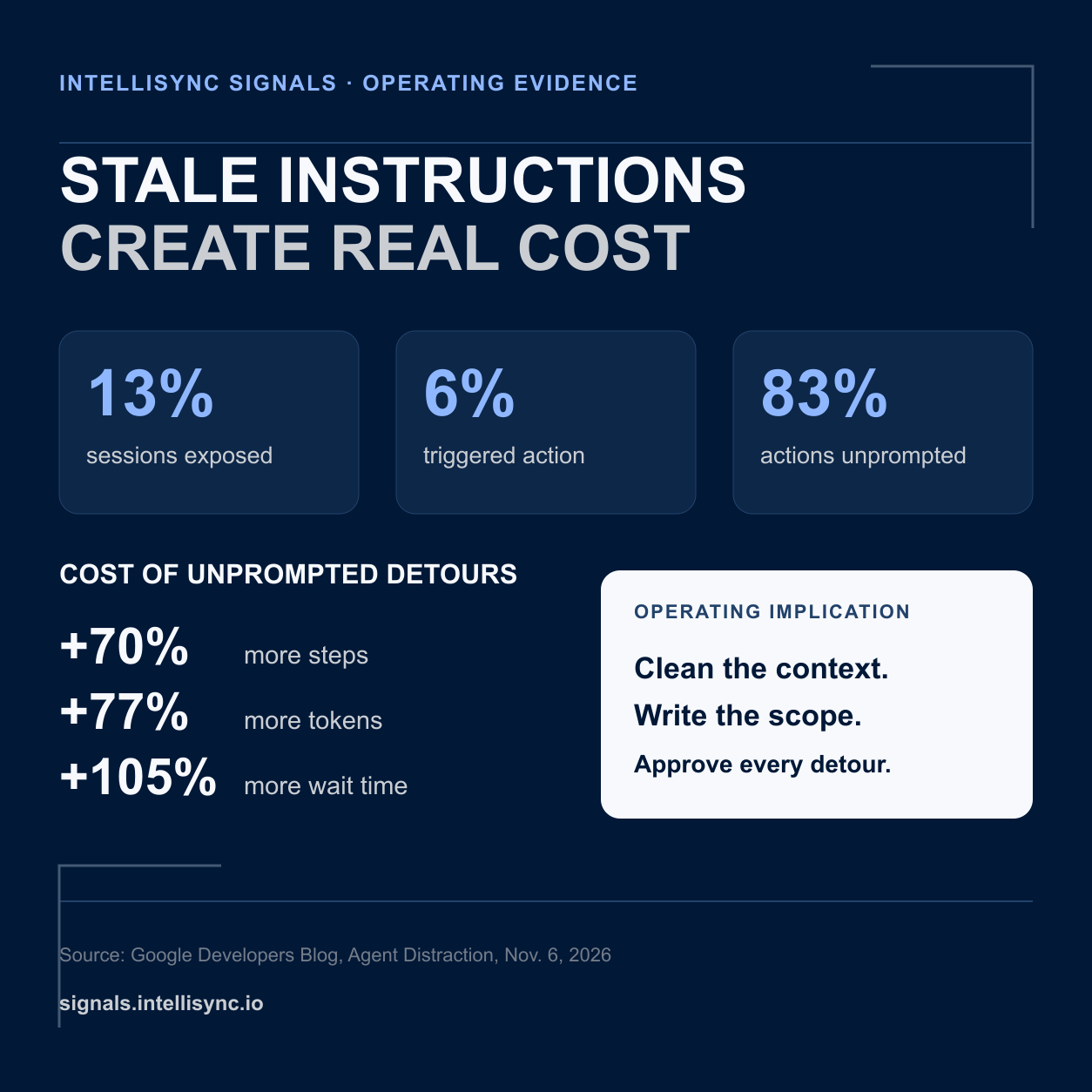
What happened. Google reported an analysis of coding-agent traces in Agent Distraction. Inline TODO or FIXME references appeared in 13% of file-reading sessions. Agents acted on 6% of those encounters, and 83% of the actions were not requested by the developer. Google associated those unprompted detours with 70% more steps, 77% more tokens and 105% more wait time. It also found that 41% chased closed work while 57% expanded into open work outside the request. These are Google results from its engineering environment, not a universal benchmark.
Why a smaller organization should care. Context is not neutral. Old comments, abandoned plans and copied instructions can become apparent work orders when an agent reads them. A human may recognize the history and move on; an agent may spend real time and money proving the wrong thing. Cleaner repositories and document stores can improve both speed and correctness.
A useful first test this week. Choose one folder an agent reads often. Find stale TODOs, superseded policies, dead links and documents without an owner or review date. Remove only items whose status you can verify; otherwise label them as context, not authority. Add an explicit rule: unrelated work becomes a note, not an edit, unless the named owner approves the scope change.
What remains uncertain. Google used bug references as a measurable proxy. Other stale context may behave differently, and cleanup can erase useful history if done carelessly. A small, stable codebase may not justify automated scanning. Start with the files involved in frequent or consequential work.
2. Put AI review settings in the same control plane as the repository
What happened. GitHub added API management and clearer evidence for Copilot code review. Administrators can manage enablement, effort and runner settings at enterprise, organization and repository levels. Results can identify AI-authored reviews, show reported custom instructions, skills and MCP servers, and display credits consumed. GitHub also states that higher-level settings cannot be overridden below them.
Why a smaller organization should care. An AI review is not one fixed product. Its instructions, tools, effort and exclusions affect what it sees and what it costs. If each repository owner configures those choices informally, two teams can receive different assurance while the dashboard calls both “reviewed.” Central settings make the rule inspectable and repeatable.
A useful first test this week. Pick one repository with customer-facing code. Record who can enable AI review, the default effort, which tools or instructions are permitted, what files are excluded and who reviews a negative finding. Request five reviews on known changes. Keep the AI attribution and consumed-credit fields with the test receipt.
What remains uncertain. A configured review is not an independent security assessment, and a three-model review can still miss a shared blind spot. The API also has token and role constraints. If your change volume is low, a required human checklist may provide more value than automated review on every pull request.
3. Count usage broadly, but judge a completed result
What happened. GitHub expanded its Copilot impact dashboard to include chat and the VS Code Agents window, covering nine experiences. It also renamed “Passive users” to “Chat-first users.” Yet chat and the agent window do not change adoption phases, one person may count in several features, and engagement means use on at least two days in a 28-day period. Separately, Google made BigQuery data-agent observability generally available, including traces, usage, latency, cost and query behaviour.
Why a smaller organization should care. Usage data answers “where did people touch the tool?” It does not answer “did the quote go out correctly?” or “did month-end close faster?” Broader telemetry can reveal hidden adoption, but it can also inflate a story if one user appears in several surfaces. Trace and cost evidence matter only when joined to a business result.
A useful first test this week. Select one repeated workflow. Track four fields for ten cases: tool surface, person responsible, completed outcome and correction required. Add elapsed time and actual usage cost when available. Report unavailable evidence as unavailable, not zero. Compare the ten assisted cases with a recent human baseline.
What remains uncertain. Small samples fluctuate, and observing a workflow can change behaviour. Some quality effects appear later than the 28-day window. If measurement adds manual burden to every case, sample one week each month instead of building a permanent dashboard.
4. When work starts in chat, preserve the business boundary
What happened. GitHub made conversation-to-code work in Slack and Teams generally available. A user can investigate a bug, create an issue, implement a change and open a pull request from a discussion. GitHub adds the initiating username to created issues and pull requests, which improves attribution, but the conversation now sits closer to consequential development actions.
Why a smaller organization should care. Chat is fast and familiar. It is also full of incomplete ideas, copied customer details and informal approvals. Moving the action button into chat can cut handoff time, but it can blur whether a suggestion was a request, a decision or merely brainstorming. The repository must remain the system of record for code and approval.
A useful first test this week. Allow one low-risk path: create a draft issue from a named channel. Require repository confirmation before code changes, a pull request before merge and the normal test and reviewer rules. Check that the initiating person, source conversation and final approver are visible without copying private chat content into a public repository.
What remains uncertain. Attribution does not prove authority, and channel membership can change. Some clients will not permit work context to enter a third-party chat integration. If conversations routinely contain sensitive information, keep the handoff manual and use a short structured issue template.
5. Route each request to the smallest capable path
What happened. Google's November 6 cloud update highlighted semantic model routing: a lightweight classifier can inspect a request and send simpler work to a lighter model while reserving more capable models for harder reasoning. The same update emphasizes production agent evaluation and deterministic guardrails around assisted infrastructure work. This is a vendor blueprint, not proof that every organization will save money.
Why a smaller organization should care. Sending every request to the most capable option can hide waste without improving the result. Yet routing adds its own failure point: a classifier can underestimate a sensitive or complex case. The useful design combines a cheap default, explicit escalation rules and an outcome test.
A useful first test this week. Take 30 completed, non-sensitive requests from one workflow. Label them simple, complex or consequential before running them. Compare a light route and a stronger route for quality, correction rate, time and actual cost. Keep consequential requests on the approved route regardless of apparent simplicity.
What remains uncertain. Vendor examples may not match your prompts, language mix or data. Small volume can make routing complexity more expensive than the savings. If monthly model spend is modest, a single tested model with a hard budget may be the cleaner choice.
6. Test the connection between systems, not only each system
What happened. Google's cloud update describes runtime protection against prompt injection and deterministic guardrails for AI-assisted migration work. Canada's federal cyber direction emphasizes asset inventory, approved configurations, containment and recovery for an AI-enabled threat environment. Together they shift attention from a model's safety promise to the controls surrounding the connections it can use.
Why a smaller organization should care. Failures often appear in the handoff: a support tool can read more customer data than intended, an integration token survives an employee departure, or an agent combines two harmless permissions into a risky action. Buying secure products does not automatically make the connection secure.
A useful first test this week. Inventory one workflow that crosses three systems. For each connection, name the credential, allowed data, permitted actions, owner, expiry and recovery step. In a test environment, verify one denied action and one revoked credential. Keep the evidence and fix the boundary before adding another tool.
What remains uncertain. External testing can be costly and advanced cyber models have restricted access. A small firm may get more immediate value from managed updates, multifactor authentication, tested backups and a clear incident contact. Never test a system you do not own or lack written authority to assess.
7. Turn Canadian AI support into one governed workflow
What happened. Canada's Budget 2026 AI measures describe skills, SME access, Canadian AI capacity and a proposed 500 MW of sovereign compute. In southern Ontario, the Regional Artificial Intelligence Initiative is accepting business applications, with a November 24 date for projects whose eligible costs start before March 31, 2027 and a final January 19 deadline. FedDev Ontario warns that costs incurred before approval are at the applicant's risk and permits only one application at a time.
Quebec's current health-transcription guidance provides a useful sector example: a product needs certification and the acquiring organization needs its own privacy impact assessment. Approval of the tool does not replace approval of the local use.
Why a smaller organization should care. Public support can reduce the cost of a meaningful adoption step. It cannot supply a business case, data authority or operating owner. The strongest proposal ties funding to one repeated workflow, a measurable baseline, a safe data boundary and a decision about what happens after the subsidy.
A useful first test this week. Write a one-page candidate: current cycle time and error rate, one user group, data involved, human approval point, expected benefit, six-week test cost and stop condition. Check program eligibility before spending. If the workflow handles regulated or personal data, separate vendor assurance from your organization's privacy and security assessment.
What remains uncertain. Budget proposals and funding applications are not delivered capacity or approved money. Program timing may not match your buying cycle. If the workflow lacks clean data or an accountable owner, use the next month to repair that foundation rather than rushing an application.
Highest-value moves
- Remove or label one stale instruction source that an agent can currently mistake for work.
- Give one AI-assisted workflow a written scope, cost ceiling, approval point and completion receipt.
- Measure ten completed cases, including corrections and unavailable evidence, before expanding access.
Today's strongest thesis
The fastest agent is useful only when the shortest path is also the approved one.
Verified sources
- Google Developers Blog: Agent Distraction
- GitHub: Copilot code review: API management and review overview updates
- GitHub: Copilot impact dashboard adds chat and VS Code agent usage
- GitHub: @GitHub in Slack and Teams is generally available and more
- Google Cloud: What's new with Google Cloud
- Google Cloud: What's new with Google Data Cloud
- Department of Finance Canada: Budget 2026: A safe and sovereign Canada
- FedDev Ontario: Regional Artificial Intelligence Initiative for businesses: When to apply
- Government of Quebec: AI transcription projects: information for health and social services professionals
- Treasury Board of Canada Secretariat: Direction on Government of Canada Cyber Security Readiness in the Frontier AI Era
Continue your decision path
Move from understanding to action.
Daily Signal: Give every agent an independent record
Seven practical signals for Canadian operators: stronger models, cheaper routing, persistent agents, independent evidence, containment, cost ownership, and correlated risk.
Read nextApply this signal to your architecture.
Identify the workflow, context, and controls to structure first.
Open Architecture Assessment