Operating question
Faster payments and automation create value only when identity, authority, current state, and completion evidence travel with every consequential action.
Decision Architecture
When Work Moves Instantly, Verification Has to Travel With It
For
Leaders and workflow owners
You will leave with
4 operating decisions
Reading mode
11 min · 10 verified sources
Reading guide9 sections · Canadian briefing+
Highest-value moves
- 01Test one verified payment handoff before automating the business action that follows it.
- 02Treat reusable AI instructions as versioned assets with owners, sources, and evaluation cases.
- 03Re-check state and authority whenever a paused workflow resumes or a person approves a machine label.
- 04Compare model data terms and infrastructure burden before selecting the newest technical option.
Canada's instant-payment launch and new AI workflow controls show how small teams can move faster without separating action from identity, approval, and proof.
Today's strongest signal: money, instructions, and automated work are beginning to move faster than the checks many small teams use to trust them.
That change is no longer limited to an AI demo. On Monday, Canada launched a payment rail that can clear and settle funds continuously. At the same time, common work platforms added reusable AI instructions, delayed automation, one-click review of machine-applied labels, broader secret detection, and another capable coding model. The useful pattern is not that every business needs more automation. It is that speed is becoming ordinary, while proof still has to be designed.
Consider a 28-person Ontario distributor. A customer pays an overdue invoice on Friday evening. The money can arrive quickly, a workflow can update the account, an AI skill can draft the release note for a held order, and a staff member can approve the document label. That sounds like one smooth path. It also creates four chances to release the wrong order: the sender may be wrong, the invoice reference may not match, the skill may use an old policy, or the approver may assume the automation already checked everything.
The opportunity is practical. Small teams can shorten cash cycles, reuse their best instructions, and let routine work wait and resume without a person babysitting it. The tradeoff is that controls must travel with the work. Identity, amount, source, version, approval, and completion evidence cannot live in a separate policy binder.
A realistic reason not to adopt a capability is weak volume or weak ownership. If your team processes six unusual payments a month, or if nobody owns the underlying procedure, automation may add a second system to reconcile without removing the first. A useful first test is narrow, reversible, and measured against a recent human baseline.
Illustrative scenario: the distributor enables instant-payment notifications for one customer group but does not release orders automatically. A rule matches the payer, amount, invoice number, and account status. The workflow drafts the release record and pauses for the credit manager. The manager sees the evidence, approves once, and the system stores the decision. After 30 clean cases, the team can decide whether any low-risk orders qualify for automatic release. This scenario is illustrative; it is not a reported deployment.
1. Canada made payments instant; businesses still need a verified handoff
What happened. Payments Canada launched the Real-Time Rail, a national system for continuous clearing and settlement with immediate funds and data-rich ISO 20022 messages. It launched with eight active participants, centralized fraud services, and a phased plan that Payments Canada says can reach more than nine in 10 Canadians within a year. The organization cites projected savings of up to $14.5 billion over a decade and says 60 per cent of Canadian businesses are ready to adopt real-time payments. The underlying Payments Canada research names cash-flow forecasting, supplier payments, account transfers, and customer collections as practical use cases.
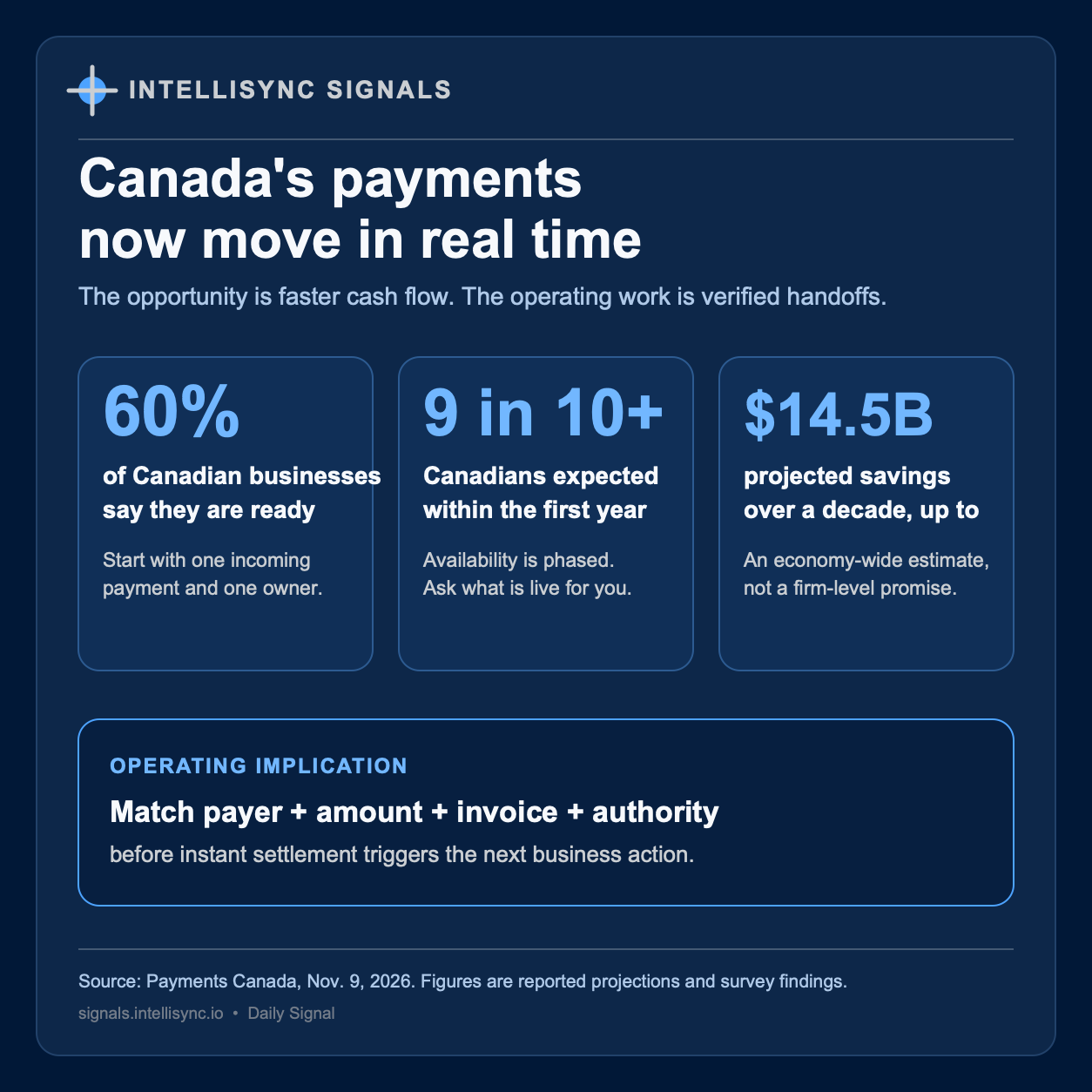
The Bank of Canada designated the rail as a prominent payment system, bringing formal oversight for risk management, resilience, and continuity. That oversight matters, but it does not decide whether a specific invoice is legitimate or whether your employee is authorized to release goods.
Why a smaller organization may care. Faster settlement can reduce uncertainty and manual reconciliation. Data that travels with the payment may help match money to an invoice without a separate email. The catch is finality: speed compresses the time available to catch a mistaken payee, duplicate instruction, or fraudulent request.
A useful first test this week. Ask your bank or payment provider what RTR capability is actually available to your account today. Pick one incoming-payment case. Define the payer, reference, amount tolerance, owner, exception path, and evidence required before the next business action occurs.
What remains uncertain. Availability is phased, and a national rail is not the same as a product your bank has enabled. The projected gains are economy-wide estimates, not promised savings for one firm. If current payments are inexpensive and easy to reconcile, waiting for broader participation may be sensible.
2. Reusable AI skills turn team know-how into a managed asset
What happened. Google is rolling out skills across Workspace and Workspace Studio. A skill is a reusable set of instructions, templates, and reference files that guides Gemini. Teams can create, test, share, and invoke skills in common work apps. Administrators can disable the feature, control external sharing, and audit activity. Copies do not automatically receive later edits, referenced Drive files still need separate permission, and the current skills support English instructions only.
Why a smaller organization may care. A good proposal outline or invoice-review checklist often lives in one person's head. A skill can make that practice repeatable without building software. It can also freeze a bad practice and scatter copies. The operating asset is therefore not just the prompt; it is the instruction, its sources, its owner, its version, and the examples that prove it works.
A useful first test this week. Choose one low-risk task completed at least weekly, such as turning approved project notes into a client update. Write the skill with one owner, allowed source folder, required output fields, and a clear instruction not to invent missing facts. Test it against five past cases, including one incomplete case. Record corrections before sharing it.
What remains uncertain. Vendor skills are new, rollout is gradual, and copies can drift. They are not yet available in every Workspace surface or language. A bilingual Canadian team may get more value from a controlled template until French instructions and synchronized version management meet its needs.
3. A workflow that waits needs a memory, an expiry, and a safe restart
What happened. Google added a Wait until step for Workspace Studio. A flow can pause inside a condition or loop, then resume at a set time or after a delay of up to 14 days. Its activity record shows the planned and actual resume times. This makes follow-ups, reminders, and staged onboarding possible inside one no-code flow.
Why a smaller organization may care. Waiting is normal business logic. Quotes expire, customers need a reminder, and managers may respond tomorrow. A durable pause can remove calendar chasing. It also creates stale-state risk. The customer, price, permission, or owner may change while the flow sleeps. Resuming the old plan without re-checking can turn a correct instruction into a wrong action.
A useful first test this week. Build a reminder that produces a draft, not a send. Store the customer record, reason for waiting, resume time, expiry time, and idempotency key—a unique value that prevents the same action from running twice. On resume, re-check consent, status, owner, and whether the action already happened.
What remains uncertain. Google reports the feature and its activity log, not your downstream application's behaviour. A two-week platform limit may not fit long sales or procurement cycles. If a human already reviews a short weekly list reliably, a new flow can be needless machinery.
4. One-click review works only when the reviewer knows the consequence
What happened. Google made it faster for authorized users to accept or edit automatically applied classification labels in Drive, Docs, Sheets, and Slides. A single label can be accepted directly; multiple labels still require review. The change reduces friction around confirmation of AI or rule-applied metadata.
Why a smaller organization may care. Classification can drive retention, sharing, security, and client handling. A quick confirmation is valuable when the label is obvious and the reviewer understands what it changes. It becomes theatre when Accept merely means “the banner looked plausible.” Human approval is a control only if the person has authority, evidence, and a meaningful choice.
A useful first test this week. Select one label with a real consequence, such as Client Confidential. Show reviewers the rule, examples, and what Accept changes. Sample 20 labeled files. Measure correct accepts, edits, uncertain cases, and time. Route uncertainty to a named owner instead of rewarding speed alone.
What remains uncertain. The release does not establish accuracy for your files. Availability differs by Workspace edition, and AI classification requires certain higher-tier products or add-ons. A small team with simple folders may be better served by a short mandatory naming rule than by buying classification automation.
5. Secrets also leak through the work around the code
What happened. GitHub's public preview can now scan completed Actions workflow logs for supported secret patterns. Findings appear with other secret alerts and remain after logs are deleted. The control is off by default, applies only to eligible enterprise security plans, does not scan older logs, and does not send preview notifications. It also excludes generic, custom, AI-detected, and already masked patterns.
Why a smaller organization may care. A key can escape without entering source code. Debug output, generated scripts, installer commands, and a helpful AI assistant can all echo sensitive values into logs. New scanning closes part of that gap. It does not replace short-lived credentials, masking, least privilege, or rotation after exposure.
A useful first test this week. Review one deployment workflow without printing secrets. List every credential it receives, its scope, lifetime, mask behaviour, and rotation owner. Use a harmless test token in a non-production repository to confirm what your current controls detect. Treat any real exposure as an incident and rotate it; do not wait for a scanner.
What remains uncertain. This preview is licensed narrowly and has explicit blind spots. Teams on other platforms need equivalent checks or stronger prevention. If a workflow can use identity federation and short-lived tokens, eliminating stored secrets may create more value than adding another detector.
6. A stronger model can carry a different data contract
What happened. GitHub made Claude Fable 5.2 generally available in Copilot. GitHub says early tests solved more tasks with fewer steps and tool calls than the prior version. The model uses provider-list usage pricing, is off by default for Business and Enterprise administrators, and requires data retention by default for safety classifiers. Certain approved enterprise customers can use a temporary zero-retention path under separate conditions.
Why a smaller organization may care. Model selection is now a purchasing, privacy, and quality decision inside the same tool. A faster or more capable option may lower rework. It may also change cost and how prompts or outputs are retained. The familiar product name does not guarantee the same data path across every model in its picker.
A useful first test this week. Before enabling a new model, classify five representative tasks by data sensitivity and consequence. Compare quality, corrections, tool calls, latency, actual cost, and retention terms. Keep client secrets and production data out unless the approved contract and configuration cover them.
What remains uncertain. Vendor early testing may not match your code, language, or review standard. Gradual rollout and eligibility rules vary. If the present model passes your tests at acceptable cost, novelty alone is not a reason to switch.
7. Open AI infrastructure is becoming real—and remains a specialist choice
What happened. Google described an open AI-native Kubernetes stack for post-training, distributed inference, and agent execution. It explicitly identifies sandbox escape and privilege escalation risks when generated commands run in shared clusters, and includes gVisor isolation and an agent runtime among the components. Separately, Google made Cloud Pathways generally available for very large accelerator fleets on GKE.
Why a smaller organization may care. Open components can reduce lock-in and support domain-specific models. They also shift integration, security, capacity planning, upgrades, and incident response onto your team. The strongest signal for most SMEs is not “build a cluster.” It is that buy-versus-build now has a credible open end—and a higher operating burden than an API call.
A useful first test this week. Write the constraint a managed service cannot meet: data location, latency, unit cost at measured volume, model control, or offline operation. Price a 30-day managed baseline first. Explore self-hosting only if the constraint is material, persistent, and owned by someone who can patch and monitor the stack.
What remains uncertain. Provider examples emphasize hyperscale workloads and do not establish SME economics. Open source reduces licence dependence, not labour or hardware cost. If your workload is modest or variable, managed inference with a spending cap may remain the cleaner choice.
Highest-value moves
- Ask what real-time payment capability your provider offers, then test one verified incoming-payment handoff without automatic release.
- Turn one weekly procedure into a versioned skill or template with an owner, evidence sources, and five past-case tests.
- Trace one automated action from credential to approval to receipt, including what happens after a delay or failed check.
Today's strongest thesis
Speed creates value only when identity, authority, and proof travel with the action.
Verified sources
- Payments Canada: Canada launches the Real-Time Rail, bringing 24/7 payment infrastructure to the national economy
- Bank of Canada: Bank of Canada designates RTR as a prominent payment system
- Payments Canada: Real time, real possibilities: 60 per cent of Canadian businesses ready to adopt real-time payments
- Google Workspace: Scale customized AI across your team with skills in Google Workspace and Workspace Studio
- Google Workspace: Pause and schedule automated workflows with the new Wait until step in Workspace Studio
- Google Workspace: Quickly confirm system-applied classification labels in Google Drive, Docs, Sheets, and Slides
- GitHub: Secret scanning detects secrets in GitHub Actions workflow logs
- GitHub: Claude Fable 5.2 in GitHub Copilot
- Google Cloud: The open AI-native stack on Kubernetes: From open models to distributed inference and agents
- Google Cloud: Cloud Pathways, a distributed ML runtime for massive accelerator fleets, now GA
Continue your decision path
Move from understanding to action.
Daily Signal: Make accepted work grow faster than the queue
Seven practical signals for Canadian operators: accepted findings, deterministic tool checks, narrow permissions, drift benchmarks, agent ownership, voice consent, and funding readiness.
Read nextApply this signal to your architecture.
Identify the workflow, context, and controls to structure first.
Open Architecture Assessment