Operating question
As AI moves from suggestions into ordinary business actions, the practical advantage is a handoff that preserves its owner, evidence, permission, acceptance checks, and proof of completion.
Decision Architecture
When AI Moves From Suggestion to Action, Check the Handoff
For
Leaders and workflow owners
You will leave with
4 operating decisions
Reading mode
12 min · 11 verified sources
Reading guide9 sections · Canadian briefing+
Highest-value moves
- 01Keep a visible owner and acceptance check between an AI suggestion and the business action it can create.
- 02Buy and evaluate a checked business outcome when AI combines tasks that once arrived separately.
- 03Package frequent work so people can run an approved version without receiving authority to change or publish it.
- 04Inventory quiet repositories and bundled Git versions before widening an agent's reach.
New scheduling actions, broader project scopes, reusable workflows, model choices, security patches, and Canadian funding point to one practical advantage: a checked handoff.
Today's strongest signal: AI is moving from suggestions into ordinary business actions, so the handoff between what the system proposes and what the business authorizes is becoming the work that matters.
Picture a 22-person Ontario equipment supplier. A salesperson writes in a team chat, “Can we meet the installer tomorrow afternoon?” An AI feature finds open times, fills in the people, and proposes a title. One click can create the meeting. That saves a few minutes. It can also invite the wrong installer, omit the project manager, or turn a rough idea into a commitment before anyone checks the job number.
The preceding 72 hours brought several versions of the same change. Chat software can turn a sentence into a calendar event. Freelance briefs are combining more kinds of work. Creative platforms are packaging reusable AI workflows. Frontier models are arriving in tools teams already use. Git issued urgent security patches, while GitHub announced that a quiet repository may stop receiving new dependency alerts.
The opportunity is a shorter path from intent to completed work. The tradeoff is that a small mistake can cross the handoff faster. A realistic reason not to adopt a feature is simple: if the team cannot name the source, owner, permission, acceptance check, and evidence of completion, another shortcut can create more reconciliation than it removes.
Illustrative scenario: the supplier enables meeting suggestions for its service coordinators but keeps the final click with the person who owns the job. Before scheduling, that person checks the project number, attendees, time zone, meeting purpose, and whether the customer agreed to the channel. After 30 meetings, the team compares time saved, corrections, missed people, and reschedules with its old process. This scenario is illustrative; it is not a reported deployment.
1. A suggested action still needs a person who owns the consequence
What happened. Google began rolling out one-click meeting scheduling inside Google Chat. When a direct message or conversation of up to five people contains a clear request to meet, Gemini can underline the text and propose as many as three times, attendees, and an editable title. A person still selects the time and clicks Schedule. At launch, the feature works on the web in English for specified Workspace editions, requires smart features and personalization, is on by default for eligible users, and has no separate administrator control.
Why a smaller organization may care. The feature removes calendar switching from a common task. The important design choice is that detection and suggestions do not create the event by themselves. A human click remains the boundary. That click is useful only when the person sees enough context to know whether the meeting is correct.
A useful first test this week. Use the feature for one recurring, low-risk meeting type. Before clicking, require five visible fields: client or project, purpose, attendees, time zone, and owner. Track wrong suggestions, missing people, reschedules, and minutes saved for 20 meetings. Keep the feature if the reduction in coordination work exceeds the new correction work.
What remains uncertain. Availability is limited by language, edition, rollout, and personalization settings. Calendar availability does not prove that someone is the right participant or has authority to commit. If your meetings are rare or often involve external people with complex constraints, a short manual confirmation may remain faster.
2. AI-related projects are combining work that used to arrive as separate tasks
What happened. The new OpenAI and Upwork research report finds that freelance demand is shifting without fitting a simple replacement story. The mix of tasks in AI-related postings became 45 per cent more diverse between early 2023 and late 2025—the equivalent of moving from 14.6 to 21.2 equally common tasks. Historically uncommon task pairs represented 8.4 per cent of pairs in an average AI-related posting, compared with 2.4 per cent in other postings. AI-related projects also carried broader scopes, larger fixed-price budgets, and more hours, while the study cautions that marketplace evidence cannot establish economy-wide job effects.
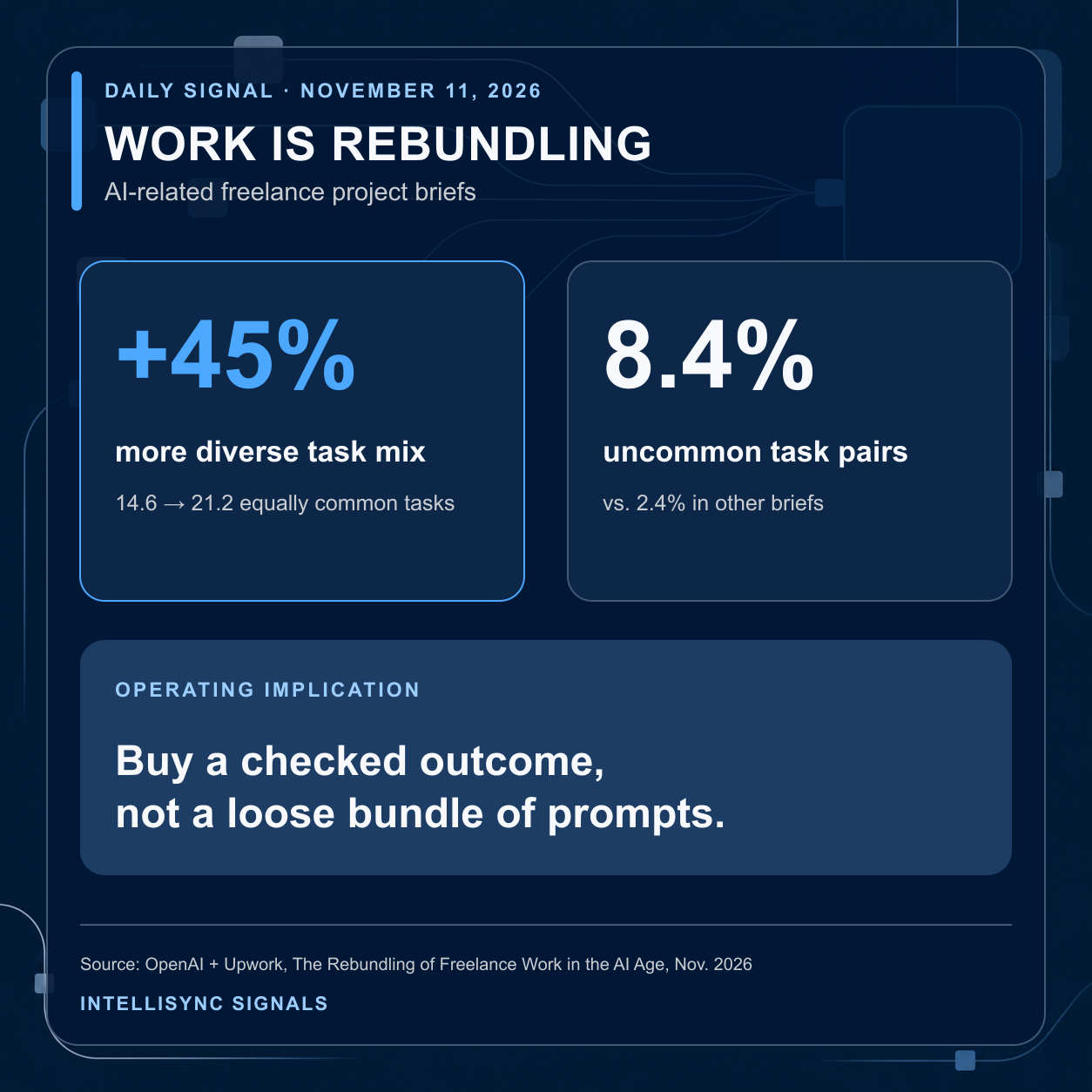
Why a smaller organization may care. Buying one isolated deliverable may no longer match the real need. A useful customer-onboarding project can involve research, copy, workflow design, integration, testing, and staff training. The opportunity is a more complete outcome. The tradeoff is a vague brief that bundles unrelated work and makes acceptance impossible.
A useful first test this week. Take one planned contractor or AI-assisted project. Replace the task list with one business outcome, three deliverables, the source material allowed, five acceptance checks, the owner of each decision, and the evidence required at handoff. Price the checked outcome against the current collection of small tasks. Keep specialist work separate when one person cannot credibly own the full result.
What remains uncertain. Upwork is one marketplace and its customers are not a proxy for every Canadian SME. Larger budgets can reflect larger scope rather than higher productivity. If your need is truly narrow—one translation, one repair, one illustration—a focused specialist can be faster and easier to review than a bundled engagement.
3. Package a repeatable workflow without giving away the decision
What happened. Adobe announced agent-led content workflow updates, including a node-based Firefly Graph for repeatable governed creative work, simplified Capsules that let others run a finished workflow, and Content Credentials tied to the organization. In a different domain, GitHub added a fine-grained permission for Copilot seat management, allowing an approved GitHub App to assign access without receiving broader enterprise administration rights.
Why a smaller organization may care. The useful pattern is separation. One person can design and change the workflow. Another can run a bounded version. A system can grant access without controlling the whole account. This makes good work easier to reuse while keeping publication, purchasing, and policy changes with the right owner. The tradeoff is version and permission maintenance.
A useful first test this week. Turn one approved, frequent task into a simple run card. Lock the sources, brand or policy version, allowed changes, output format, and acceptance checks. Let a second person run it without permission to edit the underlying workflow or publish the result. Record the version and reviewer with each output.
What remains uncertain. Adobe's announced capabilities target enterprise content operations, and GitHub's permission applies to enterprise Copilot administration. Neither proves value for a small team. If only one person performs the task a few times a year, a checklist and named reviewer may be clearer than a reusable automated package.
4. A frontier model belongs behind a task scorecard, not a default switch
What happened. Google released Gemini 4 Carbon for demanding coding, research, cybersecurity, and long-running agent work. Google also says Gemini 4 Argon remains the better fit for most software and knowledge work. Carbon's public API starts at an introductory US$2 per million input tokens and US$10 per million output tokens, then is scheduled to rise on November 30 to US$4 and US$20. Those are provider prices, not a prediction of the cost of an accepted result.
Google and Artificial Analysis also introduced a Multimodal Knowledge Agent benchmark for tasks that require reasoning across charts, drawings, tables, slides, and other visually complex files. Separately, GitHub added Carbon to Copilot with usage-based billing and administrator-controlled model access.
Why a smaller organization may care. A stronger model may help with the hardest contract review, spreadsheet, drawing set, or multi-file repair. It can also spend more, run longer, and widen the consequence of a bad instruction. The useful question is not which model ranks first overall. It is which route produces an accepted result for your document type, language, risk, and budget.
A useful first test this week. Choose five real completed cases, including English and Canadian French where relevant. Compare a deterministic method, your current model, and the frontier option. Measure accepted-result accuracy, missed evidence, corrections, elapsed time, actual usage cost, and honest refusal. Keep the frontier route only for cases where its improvement survives human review.
What remains uncertain. Vendor benchmarks and customer examples may not resemble your files. Introductory prices change, and a model available in one product may have different controls or billing elsewhere. If routine work already passes your checks, a new default can increase cost without improving the outcome.
5. Patch the Git inside the tools that agents and people actually use
What happened. The Git project released fixes for six security vulnerabilities affecting recursive clones, server-advertised references, signature removal, binary patches, large merges, and fast-import streams. The most serious described paths include code execution during a malicious recursive clone and file access outside the intended repository. GitHub recommends Git 2.56.1 or the patched release for the applicable maintenance series and notes that applications bundling Git also need updates.
Why a smaller organization may care. AI coding tools often clone, merge, inspect, or import repositories on behalf of a person. Updating the developer's terminal does not prove that a desktop app, build image, self-hosted runner, or automation uses the patched binary. The opportunity is a clean inventory. The tradeoff is interruption if an update changes a dependent workflow.
A useful first test this week. Inventory Git versions in developer laptops, desktop coding tools, containers, CI runners, deployment images, and any agent sandbox. Patch a disposable environment first, run clone, merge, submodule, and deployment checks, then roll forward. Until patched, avoid recursive clones and merges from untrusted sources. Do not treat that temporary restriction as a substitute for the update.
What remains uncertain. Exposure depends on how each environment receives and processes untrusted repository content. A hosted service may patch its own layer while your bundled client remains old. If your team cannot identify which Git binary a tool invokes, pause untrusted repository work in that tool until the vendor or owner can provide evidence.
6. A quiet repository can still be a live business dependency
What happened. GitHub announced that Dependabot alerts will pause on most repositories with no activity for one year beginning December 8. Existing alerts will be archived rather than deleted. A push or manual re-enable restores them, and enforced security configurations can keep alerts on.
Why a smaller organization may care. “No code changed” does not mean “nothing depends on it.” A small company may have an old website, integration, kiosk, or internal utility that still processes real data. Paused alerts can turn silence into a false sense of safety. The opportunity is to separate truly archived software from quiet but operating software.
A useful first test this week. List repositories with no push in the past year. For each, record whether it is deployed, reachable, scheduled, embedded in another product, or used for recovery. Keep monitoring on for anything live. For a true archive, remove credentials, document the last supported state, make the deployment boundary clear, and decide whether it can be deleted later through a separate approved process.
What remains uncertain. GitHub's rule does not apply identically to every plan and deployment. Re-enabling an alert does not patch a dependency, and a recent cosmetic push does not prove maintenance. If the repository has no owner and no safe test path, replacing or retiring the service may be more realistic than pretending to maintain it.
7. Canadian AI funding rewards a defined project, not a general wish to adopt
What happened. Canada's expanded Regional Artificial Intelligence Initiative now totals $700 million in federal funding across adoption, commercialization, and regional support. Details and intake dates vary by regional development agency. In southern Ontario, FedDev Ontario's current intake asks projects with eligible costs before March 31, 2027 to apply by November 24, 2026; the final deadline is January 19, 2027. Costs incurred before a formal decision remain the applicant's risk.
Why a smaller organization may care. Funding may help a firm tackle integration, training, governance, cybersecurity, or commercialization that a normal software budget cannot absorb. The tradeoff is application work, reporting, and the possibility of spending before approval. A funding deadline can also tempt a team to describe a tool purchase as a transformation without a measurable workflow.
A useful first test this week. Write a two-page project brief before opening an application: current process, baseline time and error rate, target outcome, affected roles, data boundary, vendor or build choice, cybersecurity controls, adoption plan, budget, owner, and evidence after 90 days. Ask the regional agency whether the project and timing fit before incurring costs.
What remains uncertain. Eligibility, repayment, priority sectors, and timing differ by region and applicant. Funding is not approval of a vendor or proof of value. If your process lacks a baseline or an accountable owner, spend a week measuring it before turning the idea into a larger financed project.
Highest-value moves
- Test one AI-suggested action with a visible owner, five required fields, and a correction measure before making it routine.
- Package one frequent workflow so people can run the approved version without gaining permission to change or publish it.
- Inventory quiet repositories and bundled Git versions before buying a stronger model or expanding an agent's reach.
Today's strongest thesis
AI creates useful speed when every handoff keeps its owner, evidence, permission, and proof of completion.
Verified sources
- Google Workspace: Schedule meetings in a single click from conversations in Google Chat
- OpenAI and Upwork: The Rebundling of Freelance Work in the AI Age
- Adobe: Adobe Brings Agentic AI to the Content Supply Chain with CX Enterprise Coworker
- GitHub: GitHub App support for Enterprise Copilot seat management
- Google: Gemini 4 Carbon is now available
- Google DeepMind and Artificial Analysis: Introducing the Multimodal Knowledge Agent benchmark
- GitHub: Gemini 4 Carbon in GitHub Copilot
- GitHub: Git security vulnerabilities announced
- GitHub: Dependabot alerts will pause on inactive repositories
- Innovation, Science and Economic Development Canada: Regional Artificial Intelligence Initiative
- FedDev Ontario: Regional Artificial Intelligence Initiative for businesses: When to apply
Continue your decision path
Move from understanding to action.
Daily Signal: Make accepted work grow faster than the queue
Seven practical signals for Canadian operators: accepted findings, deterministic tool checks, narrow permissions, drift benchmarks, agent ownership, voice consent, and funding readiness.
Read nextApply this signal to your architecture.
Identify the workflow, context, and controls to structure first.
Open Architecture Assessment