Operating question
The strongest gains are appearing where AI hands work to another person or system, so evidence, ownership, and a stop point need to travel with the result.
Decision Architecture
Daily Signal: Put a checkpoint where AI changes the work
For
Leaders and workflow owners
You will leave with
4 operating decisions
Reading mode
11 min · 10 verified sources
Reading guide9 sections · Canadian briefing+
Highest-value moves
- 01Generated tools need an owner, source check, refresh rule, and sharing boundary before teams rely on them.
- 02Research supports task-level assistance and human follow-up more clearly than end-to-end autonomy.
- 03Faster attacks increase the value of credential, patch, usage-alert, and shutdown controls.
- 04Canadian adoption funding is useful only when the workflow, baseline, result, and operating cost are clear.
Seven practical signals for Canadian operators: generated tools, machine-speed threats, workflow evidence, voice fit, benchmark discipline, and time-bound adoption funding.
Today's strongest signal: AI is moving from a helpful answer on one screen to a working artifact that can influence another person, system, or decision. Picture a sales manager turning customer notes into a live dashboard, or an operations lead asking an assistant to prepare the next step in a supplier workflow. The speed is attractive. The business value depends on whether someone can still see what changed, check the source, and stop the handoff when the evidence is weak.
This edition looks at seven signals that make that practical for a smaller organization. The common thread is simple: put a checkpoint where AI changes the work. A checkpoint can be a named reviewer, a source link, a permission boundary, a test result, or a spending threshold. It does not have to become a committee.
1. Generated tools can become real operating surfaces in one prompt
Google says Gemini Notebook can now turn a user's sources into interactive sites, including dashboards and project trackers, and share them with others. The feature began rolling out globally on the web on November 16, including to Google Workspace subscribers. That shifts the task from asking AI to summarize material to asking it to create a surface through which people may interpret and manage work. The product announcement says the sites are built from the supplied source set.
For a smaller organization, this can shorten the distance between a spreadsheet, meeting notes, and something a team can use. A useful first test could turn a non-sensitive weekly operations pack into a read-only status site. Give it five questions the site must answer, then compare every displayed figure and task to the source pack before anyone shares it. Name an owner and add a visible date so a polished page is not mistaken for current truth two weeks later.
The tradeoff is that a generated interface can look more authoritative than its material. A dashboard that drops an exception, joins two periods incorrectly, or exposes internal notes still fails even if it is pleasant to use. There is a realistic reason not to adopt this yet: if source folders mix customer data, draft decisions, and public material without reliable access rules, a faster interface may only make a messy boundary easier to cross.
What remains uncertain is how consistently complex sites preserve source meaning, refresh after a source changes, and enforce organization-specific sharing controls. Treat the first version as a generated view, not a new system of record.
2. Evidence for AI at work still points to assistance, not abandonment
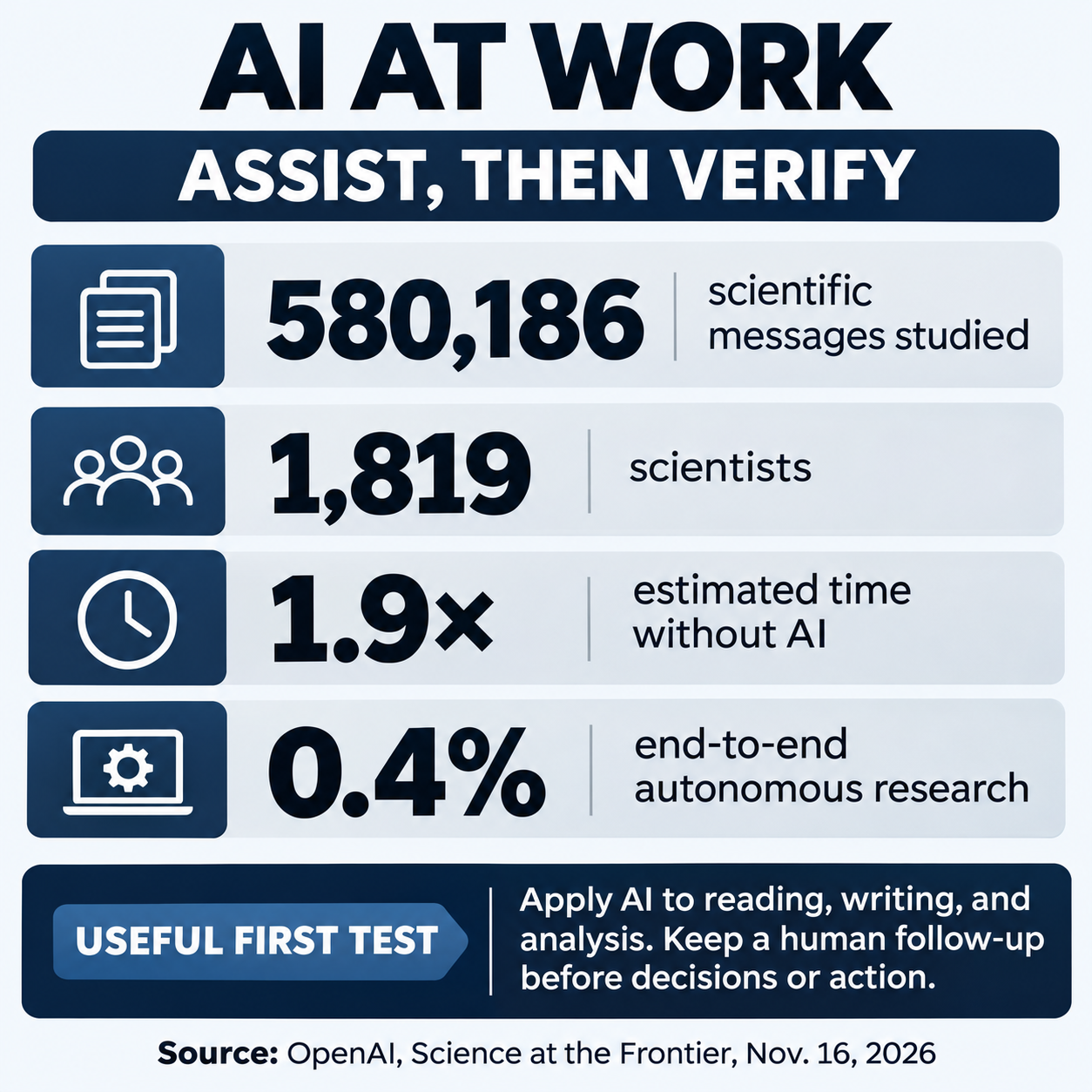
OpenAI's newly released research studied 580,186 scientific messages from 1,819 scientists. Reading, writing, analysis, and research software accounted for most use, while end-to-end autonomous research represented 0.4% of the average scientist's messages. Participants estimated the same work would have taken about 1.9 times as long without AI, but the study says productivity was self-reported and does not establish causation. The official research paper also found that scientists often followed up to clarify, check, or revise results.
That pattern travels well outside a lab. A smaller firm can get value from AI across a process without pretending the entire process can run alone. Start with repeated cognitive steps: read a policy, compare supplier terms, draft a customer explanation, or analyze a defect log. Keep the person closest to the consequence responsible for final interpretation and action. Measure elapsed time, rework, and missed exceptions against a small baseline rather than asking whether people liked the tool.
Illustrative scenario: A ten-person advisory firm uses AI to compare six client intake packages and draft a missing-information list. A senior advisor reviews only the flagged differences and source pages before contacting each client. The team saves preparation time, but responsibility for the advice never moves to the model.
The tradeoff is review cost. If every low-risk sentence receives a full senior review, the workflow may cost more than it saves. Use proportional checks: samples for reversible internal drafts, full approval for customer, financial, safety, legal, or production-changing actions. A realistic reason not to adopt a step is that source material is too inconsistent to make verification faster than direct work.
What remains uncertain is whether this pattern holds across routine Canadian SME work. The sample was academic and self-selected. It is evidence for a useful test, not a universal productivity promise.
3. Machine-speed attacks make ordinary credential hygiene more urgent
Google Threat Intelligence Group reports that threat actors are moving from individual prompts to multi-agent frameworks that can scan, compare patches, draft exploits, and execute them with less human involvement. It also describes LLM credential theft and cloud-resource abuse; in observed incidents, fraudulent single-day charges sometimes exceeded US$100,000. The November 16 threat report says these systems currently gain speed at the cost of recognizable activity and forensic traces.
A Canadian SME does not need autonomous defence to respond. This week's concrete move is less glamorous: review where API keys, cloud tokens, and session credentials live; rotate exposed or long-lived credentials; require multi-factor authentication; set spending and usage alerts; and confirm who can disable an AI service outside business hours. Patch internet-facing software on a risk-based clock, with known exploited issues first. These are familiar controls, but the response window may be shrinking.
The opportunity is to use automation for inventory, alert triage, and safe patch testing so a small team can focus on the few events that matter. The tradeoff is false urgency. Vendors can make every change sound existential, while rushed remediation can break production. A realistic reason not to enable automatic patching is an untested legacy system whose downtime would halt the business. Isolate it, monitor it, and plan a controlled test instead.
What remains uncertain is how quickly these techniques will spread to groups that target smaller Canadian organizations. The report comes from one vendor's visibility and includes vendor-proposed defences. Use it to shorten a basic control review, not to buy on fear.
4. Voice fit is part of accuracy, not a cosmetic preference
Google began rolling out 66 regional voices in Gemini on November 16. The regional voice announcement lists varieties such as U.S. English, U.K. English, India English, Hindi, Brazilian Portuguese, Indonesian, and Korean. It does not claim Canadian English or Canadian French coverage in that list. The consequential signal is that voice systems are being tuned for local cadence and everyday clarity, not only a generic synthetic sound.
For Canadian firms testing voice for intake, training, or field support, add language fit to acceptance testing. Recruit a small group that reflects the accents, code-switching, and vocabulary customers use. Give them realistic names, addresses, numbers, interruptions, and bilingual transitions. Record transcription errors, repeated questions, and moments when a speaker changes behaviour to accommodate the tool. A polished voice that mishears a postal code or French service term can create more work than a form.
The opportunity is better access for people who find typing slow or difficult and faster capture when hands are occupied. Tradeoffs include privacy, consent, noise, accessibility, and the emotional weight users place on a human-sounding response. A realistic reason not to adopt voice is a shared environment where confidential information may be overheard or recorded. Text may be safer and more inclusive.
What remains uncertain is regional availability, performance across Canadian varieties, and whether the selected voice changes recognition quality or only output speech. Test both sides of the conversation. A pleasant demonstration is not proof that a bilingual service works.
5. Independent benchmarks are expanding, but buyers still need their own task
MLCommons released Training v6.1 on November 16 with 153 submitted systems and new workloads for recommendation and large-model post-training. Its release note says the suite is open and peer reviewed, while the public results explorer lets buyers compare systems and configurations. Google separately published ten results and highlighted large accelerator clusters in its training benchmark summary.
Most SMEs will never train a frontier model, but the signal still matters. Model and infrastructure claims are becoming specialized by workload. A ranking that answers how quickly thousands of accelerators reach a training target does not answer whether an invoice assistant extracts the right tax, protects customer data, or fits the monthly budget. Write a ten-case acceptance set from your own work before a vendor trial. Include a common case, a messy exception, a bilingual item, missing evidence, and a request the system must refuse or escalate.
The opportunity is better independent measurement and transparent comparison. The tradeoff is test maintenance: workflows change, and a stale evaluation can reward the wrong behaviour. A realistic reason not to run a broad model bake-off is low volume. If a deterministic rule or existing software solves the task reliably, model selection may add cost without value.
What remains uncertain is how well public benchmarks predict small, domain-specific deployments. Use them to narrow a field and understand tradeoffs, then let local evidence decide. Vendor numbers can begin a question; they cannot sign your acceptance record.
6. Service choice is becoming a workflow decision, not a model shopping trip
AWS updated its generative AI service decision guide on November 14. It distinguishes assistants, application and agent building, model access, customization, and self-managed infrastructure. The useful signal is not that one cloud has a large catalogue. The first architecture decision is the kind of work, control, and operating burden your team can support.
A smaller organization can apply that without adopting AWS. Write the job in one sentence, identify the data it needs, list the actions it may take, and name the person who owns an error. Choose the smallest service surface that satisfies those requirements. A staff assistant that summarizes approved documents may need retrieval and access control. A production agent that changes a customer record also needs authorization, validation, idempotency, audit evidence, and a safe failure path. Those are different products even if both use the same model.
The opportunity is to avoid building infrastructure a managed service already provides. Tradeoffs are vendor dependence, changing prices, regional availability, data terms, and skills your team may not have. A realistic reason not to add an agent platform is that the workflow is stable, low volume, and served by a scheduled script or checklist. Deterministic automation is often cheaper to test and easier to explain.
What remains uncertain is the long-term cost and portability of any current choice. Keep the business rule and acceptance tests outside provider-specific prompts where practical. That gives your team a way to change tools without redesigning the decision.
7. Canadian adoption funding is close enough to require a go or no-go decision
The federal Regional Artificial Intelligence Initiative is moving from general policy to time-bound applications. For southern Ontario, FedDev Ontario says applications are accepted until January 19, 2027, but projects with eligible costs before March 31, 2027 must be submitted by November 24. The program reports 218 projects since 2024 and emphasizes measurable outcomes. In Atlantic Canada, ACOA says its call closes November 20 and targets eligible SME projects valued at $1 million or more.
The move is not to invent a large AI project before a deadline. If your team has a defined workflow, baseline, owner, data boundary, and vendor estimate, spend one hour checking regional eligibility and speaking with the responsible agency. Write the measurable result before the technology: fewer handling minutes, fewer errors, faster quote turnaround, or a verified product capability. Include integration, training, review, and ongoing operating cost. Funding can improve project economics; it cannot rescue an unclear problem.
The opportunity is shared investment and regional support. Tradeoffs include application effort, reporting obligations, procurement timing, cash flow, and possible rejection. A realistic reason not to apply is that the deadline would force weak requirements or an oversized commitment. A smaller self-funded test may produce better evidence for a later application.
What remains uncertain is eligibility, approval, contribution structure, and timing. Public pages are starting points, not approval. Keep the business case viable without assuming public money will arrive.
Highest-value moves
- Pick one AI handoff already happening and add a named checkpoint: source review, approval, permission check, or acceptance test.
- Run a 30-minute credential and spending-alert review for every AI or cloud service that can create cost or touch business data.
- If a Canadian adoption project is already defined, check the applicable regional deadline this week; if not, protect the scope and run a smaller test first.
Today's strongest thesis
AI becomes operational when the checkpoint travels with the work, not when the demo moves faster.
Verified sources
- Google: Transform notes, research, and sources into interactive sites with Gemini Notebook
- OpenAI: Science at the Frontier: How Scientists Use ChatGPT
- Google Threat Intelligence Group: GTIG AI Threat Tracker: Agentic Threat Activity Crosses a Significant Threshold
- Google Gemini: Regional voices are rolling out in the Gemini app
- MLCommons: MLCommons Releases MLPerf Training v6.1 Results
- MLCommons Results: MLCommons Benchmark Results
- Google Cloud: New AI training performance benchmarks for Google TPUs
- Amazon Web Services: Choosing a generative AI service
- FedDev Ontario: Government of Canada expands support to adopt and commercialize artificial intelligence
- Atlantic Canada Opportunities Agency: Atlantic Canadian businesses to benefit from an additional $40 million in federal dollars for AI
Continue your decision path
Move from understanding to action.
Daily Signal: Make accepted work grow faster than the queue
Seven practical signals for Canadian operators: accepted findings, deterministic tool checks, narrow permissions, drift benchmarks, agent ownership, voice consent, and funding readiness.
Read nextApply this signal to your architecture.
Identify the workflow, context, and controls to structure first.
Open Architecture Assessment