Operating question
The next useful AI advantage is not simply faster output; it is the ability to reuse evidence, permissions, context, and evaluation without asking people to rebuild trust from scratch.
Decision Architecture
Daily Signal: Stop rebuilding trust on every AI task
For
Leaders and workflow owners
You will leave with
4 operating decisions
Reading mode
11 min · 10 verified sources
Reading guide10 sections · Canadian briefing+
Highest-value moves
- 01Map providers, intermediaries, owners, and exit paths before an AI service becomes hard to replace.
- 02Reuse context and evidence only after a workload-specific test proves the savings and preserves isolation.
- 03Keep risk scores, document extraction, and model benchmarks subordinate to visible evidence and named authority.
- 04Treat patching and funding readiness as part of the AI workflow, not separate administrative work.
Eight practical signals for Canadian operators: provider policy, context caching, grounded documents, repeatable reviews, reusable expertise, honest evaluation, urgent patching, and adoption funding.
Today's strongest signal: the expensive part of AI is shifting from producing an answer to proving that the answer belongs in the work. Picture a familiar Monday: a controller receives a 70-page supplier packet, an account manager resumes a long customer file, and an owner reviews an AI proposal that touches three systems. The tools can respond quickly. The team still has to find the source page, confirm the permission, understand the cost, and decide who owns the result.
The strongest signals from the past 72 hours make that handoff more concrete. Providers are reducing repeated computation, attaching page-level evidence to extracted values, packaging business context for reuse, and proposing common measures of model progress. At the same time, policy changes, an actively exploited infrastructure flaw, and Canadian funding programs show why speed cannot become a substitute for authority or readiness.
1. Check the provider chain before the next renewal
OpenAI's updated Usage Policies took effect on November 20. Among the changes, services that provide direct access to OpenAI models, such as model routers or AI gateways, need review and approval from OpenAI. The detailed policy update also clarifies restrictions for high-stakes uses and model-access intermediaries. A model-access intermediary is a service that sits between your application and the underlying model provider.
For a smaller organization, this is a contract and continuity question, not a reason to panic. If your workflow uses a gateway, bundled vendor, white-label assistant, or consultant-managed account, ask which provider terms apply, who receives notices, and what happens if access changes. A useful first test is one page for every important AI service: provider, intermediary, approved use, data location, renewal date, exit method, and named owner.
The opportunity is choice. A gateway can simplify billing, routing, and fallback models. The tradeoff is another policy and support boundary. A realistic reason not to add one is a simple workload already served well by a direct provider relationship.
What remains uncertain is how each intermediary will implement the new approval requirement. Do not infer non-compliance from silence. Ask for current written confirmation and keep a tested exit path.
2. Reuse repeated context only when the workload earns it
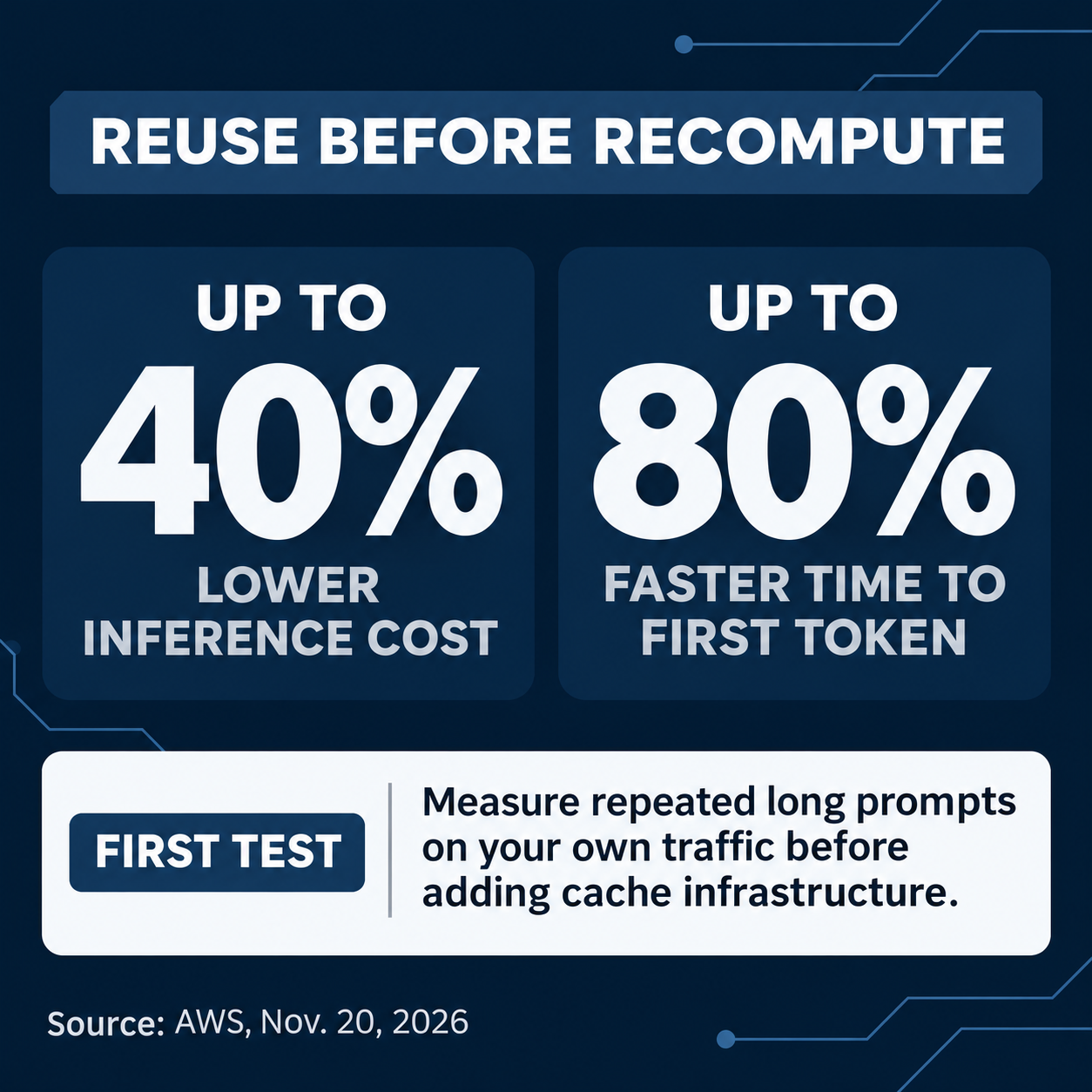
AWS says distributed key-value, or KV, caching can reduce self-hosted model inference cost by up to 40% and time to first token by up to 80%. A KV cache stores intermediate attention calculations so a model does not recompute the same long prompt every time a conversation resumes on another server.
The headline figures are useful, but AWS also describes the more important operating test. Short prompts may take longer to load than to recompute. Savings depend on prompt length, repetition, routing, cache hit rate, and whether freed capacity actually lets the team run fewer servers or serve more work. Sensitive tenants may also need separate caches or tenant-specific keys.
A useful first test is a representative business day of one repeated, long-context workflow. Measure first-token delay, repeated-token volume, cache-hit scenarios, infrastructure cost, and output consistency. Compare the cache cost with the value of the delay removed.
The opportunity is faster resumed work without buying more model capacity. The tradeoff is another data and infrastructure layer. A realistic reason not to adopt it is that your team uses hosted APIs, short prompts, or low repeat traffic.
What remains uncertain is the result on your own workload. Treat the 40% and 80% figures as a ceiling to test, not a forecast to budget.
3. Document automation is more useful when every value has a page
AWS made Textract Insights generally available on November 20. The service lets a team describe desired fields in natural language, submit a document or mixed packet, and receive structured values with a confidence score and page-level grounding. Grounding means the system points back to the source location that supports an extracted value.
That changes a practical workflow. A person reviewing leases, invoices, insurance forms, purchase orders, or intake packets can start from a proposed table and jump to the supporting page instead of searching the whole file. It does not make the value automatically correct. Confidence is a prioritization signal, and page evidence still needs the right reviewer when money, rights, or customer commitments are involved.
Illustrative scenario: a 24-person construction supplier receives vendor packets in several formats. The system proposes payment terms, insurance expiry, and delivery constraints. A coordinator checks every low-confidence field and every field that changes a purchase decision, then records the page used. The team saves search time without letting extraction become approval.
A useful first test is 30 completed packets with known answers. Measure exact-field accuracy, missing fields, reviewer minutes, and the errors that would matter financially. The opportunity is faster intake. The tradeoff is setup, review design, and document handling. A realistic reason not to adopt it is low volume or already-structured data.
What remains uncertain is performance on your layouts, handwriting, bilingual forms, and poor scans. Test those cases deliberately.
4. Standardize risk review without outsourcing the decision
Standard Bank Group described an assessment built with AWS that scores generative AI use cases against international standards and internal policies. The goal is consistent, traceable evidence for a risk committee. In Canada, an open Innovative Solutions Canada challenge seeks tools for AI decision-process visibility, traceability, and compliance governance, showing that explainable review is becoming a procurement need as well as an internal control.
The useful pattern is not to let one model approve another. It is to standardize intake, evidence, scoring criteria, exceptions, and the route to a responsible person. A model can flag missing information or map a use case to policy questions. Deterministic rules can block a prohibited data type or missing owner. A person can decide whether the remaining evidence is good enough for the business.
A useful first test is five existing AI uses. Ask the same questions each time: purpose, data, users, decisions affected, tools, permissions, failure impact, monitoring, rollback, and owner. Compare automated findings with an experienced reviewer and record disagreements.
The opportunity is a faster, more consistent first pass. The tradeoff is false precision from a neat score. A realistic reason not to automate is a small portfolio that one accountable reviewer can assess reliably.
What remains uncertain is how well automated scoring handles unusual context. Keep the evidence visible and the approval authority human and named.
5. Reusable context needs an owner, not just a connector
Microsoft's Ignite Book of News says Microsoft IQ is now generally available as an enterprise context platform. It connects agents to work, business data, unstructured content, and outside information, while letting teams reuse business plugins, skills, tools, and agents with sensitivity labels and audit controls. Microsoft says the goal includes better results and less unnecessary context.
For a Canadian SME, the product name matters less than the design choice. A sales follow-up skill, service-triage guide, or purchasing rule can become reusable business knowledge. Someone still has to say which source is authoritative, who may change it, which team inherits it, and when it expires. Otherwise the organization scales old instructions faster.
A useful first test is one repeated decision that crosses two teams. Package the approved instructions, examples, source links, allowed tools, and escalation rule. Name an owner and review date. Test it on ten real cases and compare accepted results with the current process.
The opportunity is less reinvention and more consistent service. The tradeoff is governance work and the risk of turning local habits into permanent rules. A realistic reason not to centralize is that the process is still changing weekly; a short checklist may be easier to revise.
What remains uncertain is portability across vendors and agent harnesses. Keep the core guidance in a format your organization owns, even if one platform distributes it.
6. One model metric cannot answer a workflow question
OpenAI proposed perplexity as a shared measure for tracking pretraining progress and informing safety standards. Perplexity measures how well a model predicts the next token; lower is better. The November 22 paper also states clear limits: datasets differ across labs, the measure is detached from specific tasks, and it does not capture every capability gain.
That is a helpful reminder for buyers. A general model benchmark can indicate direction, but it cannot tell an accounting firm whether a tax-research summary cites the right source, or a manufacturer whether a quality alert arrives in time. The workflow needs its own case set, acceptance rule, and failure categories.
A useful first test is 20 representative cases from one decision. Score factual support, completeness, time saved, reviewer effort, and the cost of a wrong answer. Freeze the cases before comparing models. Record the requested model and the model actually used when a platform exposes that information.
The opportunity is to benefit from model progress without rebuilding the whole process on every release. The tradeoff is maintaining a small but meaningful evaluation set. A realistic reason not to chase a new model is that the current route already clears the business threshold at lower cost and lower change risk.
What remains uncertain is which general metric will become comparable across providers. Your acceptance test can remain stable while the industry debates that question.
7. Patch the platform before adding another intelligent layer
The Canadian Centre for Cyber Security updated its VMware advisory on November 20 after a vCenter vulnerability was added to the US Known Exploited Vulnerabilities catalogue. The advisory lists affected product lines and directs administrators to vendor updates. An actively exploited management-layer flaw matters even when the current project is described as an AI initiative.
Smaller organizations often buy AI through existing cloud, virtualized, identity, browser, and data systems. Those foundations still carry the access. A new assistant does not compensate for an exposed management plane, stale identity, or unowned patch.
A useful first test is to ask the managed service provider or internal owner whether any listed VMware products exist, which versions run, whether exposure is internet-facing, and what evidence confirms remediation. Keep the request bounded to the advisory; do not accept a generic statement that systems are monitored.
The opportunity is to use the AI project as a reason to clarify asset ownership and evidence. The tradeoff is that urgent patching can interrupt planned work and needs rollback discipline. A realistic reason not to make an emergency change is confirmed non-exposure or a vendor-approved mitigation, documented by the accountable owner.
What remains uncertain is your environment. The advisory is a prompt to verify, not proof that your organization is affected.
8. Fund a defined workflow, not an AI shopping list
Ontario's current funding directory lists an open Advanced Manufacturing and Innovation Competitiveness stream focused on SMEs and technology adoption, skills, jobs, investment, and measurable business growth. The federal visibility-and-traceability challenge is also open, but it targets innovators building a solution for a defined public need. Both point to the same discipline: a credible project starts with an outcome and an owner, not a catalogue of AI features.
A useful first test is a one-page investment case for one workflow. State the baseline delay or cost, target outcome, eligible work, data readiness, integration needs, adoption plan, evaluation method, cash-flow requirement, and what continues if support is delayed. Confirm details with the responsible program before relying on eligibility or timing.
The opportunity is to share the cost of a real modernization or commercialization effort. The tradeoff is application time, reporting, procurement, and the risk of spending before a decision. A realistic reason not to apply is that the deadline or program shape would push the team into a larger project than the evidence supports.
Do not treat funding as proof of product-market fit. A small unfunded test can be the stronger next move if it resolves the largest uncertainty.
What remains uncertain is selection, timing, and the final agreement. Build a case that still makes business sense without the contribution.
Highest-value moves
- Map the provider and intermediary behind one important AI workflow, including its renewal date, owner, and tested exit path.
- Build a 20-case acceptance set for one repeated decision, with evidence, reviewer time, and costly-error checks.
- Verify one foundation control this week: patch status, permission scope, or source-page evidence for a consequential output.
Today's strongest thesis
The fastest AI workflow is the one that does not make people rebuild trust from scratch.
Verified sources
- OpenAI: Broad access through consistent standards
- OpenAI: Usage policies
- AWS Artificial Intelligence: Cut self-hosted LLM cost and latency with the distributed KV caching agent skill
- AWS Artificial Intelligence: Announcing Amazon Textract Insights: Verifiable generative AI for documents
- AWS Artificial Intelligence: How Standard Bank Group automates AI risk assessment for generative AI
- Innovation, Science and Economic Development Canada: Innovative Solutions Canada
- Microsoft: Microsoft Ignite 2026 Book of News
- OpenAI Research: Perplexity and Intelligence
- Canadian Centre for Cyber Security: VMware security advisory AV26-1185 Update 1
- Government of Ontario: Available funding opportunities from the Ontario Government
Continue your decision path
Move from understanding to action.
Daily Signal: Make accepted work grow faster than the queue
Seven practical signals for Canadian operators: accepted findings, deterministic tool checks, narrow permissions, drift benchmarks, agent ownership, voice consent, and funding readiness.
Read nextApply this signal to your architecture.
Identify the workflow, context, and controls to structure first.
Open Architecture Assessment