Operating question
The useful AI advantage is no longer just faster output; it is a work design that preserves human attention, develops judgment and tests the real task before authority expands.
Human-Centered Architecture
Keep the Learner in the Loop
For
Leaders and workflow owners
You will leave with
4 operating decisions
Reading mode
12 min · 11 verified sources
Reading guide9 sections · Canadian briefing+
Highest-value moves
- 01Review capacity can become the real bottleneck when agents generate more work than a team can check.
- 02Automation plans need an explicit apprenticeship path so speed today does not erase judgment tomorrow.
- 03Public benchmarks are useful signals, but local workflow tests must determine whether authority can expand.
- 04Open weights and lower prices increase choice while making routing, operations and evidence more important.
New evidence on AI-heavy work points to a practical rule for smaller organizations: protect attention, apprenticeship and proof as output accelerates.
Today's strongest signal: an AI system can produce work faster than a small team can read it, but the team still owns the customer promise, the exception and the next generation of expertise. Picture a service manager opening Monday with twelve polished drafts, three proposed process changes and two confident answers that conflict. The bottleneck is no longer typing. It is deciding what deserves attention, who is learning from the work and what evidence is good enough to act.
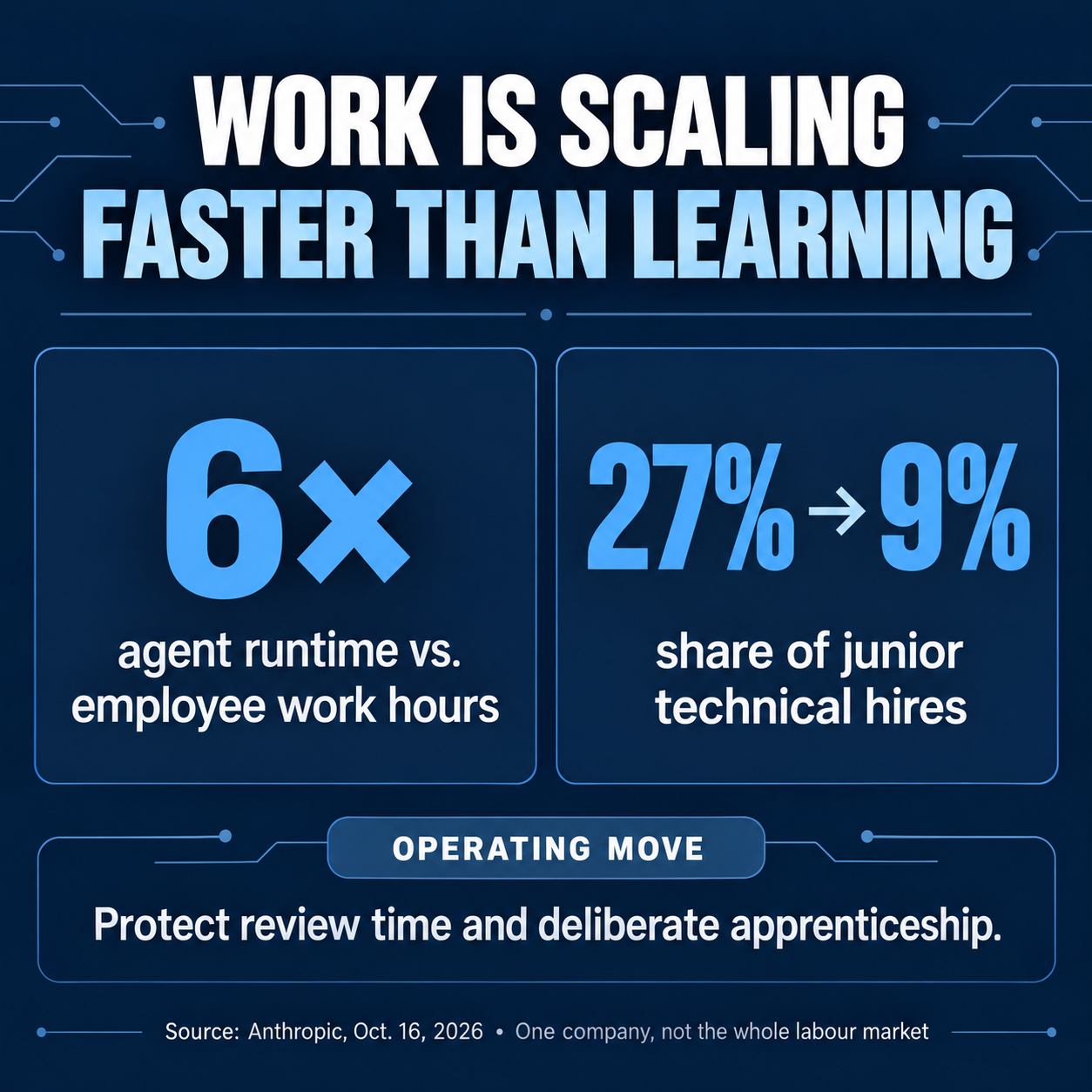
That shift became unusually visible in new research from one frontier AI company. Anthropic reports that employee-directed agents were running six times as many hours as employees worked by August. The same report says the share of junior technical hires fell from 27% to 9%. Those are company-reported figures from one fast-growing firm, not a forecast for the Canadian labour market. They are still a useful early warning: output can scale before review capacity, coaching and role design catch up.
For a Canadian SME, the opportunity is real. A capable assistant may clear routine analysis, prepare customer material or test code while the team sleeps. The tradeoff is that automation can remove the very first-pass work through which people learn the business. A useful first test is therefore not “How many tasks can we automate?” It is “Which work can accelerate while still building judgment, preserving accountability and leaving enough evidence for a person to check?”
Illustrative scenario: A 35-person Ontario equipment distributor gives an agent the first pass on quote preparation. The agent assembles product matches, delivery assumptions and margin checks overnight. A junior coordinator then reviews one representative quote from each risk category, explains any correction and records the reason. The firm gains speed without turning development into passive approval. The scenario is illustrative, not a reported case.
1. Human attention becomes the scarce production input
The headline from Anthropic's October 16 employment study is not simply that agents did more work. The report describes people spending more time reading outputs, building monitoring views and managing several agent streams. Even non-technical employees could need about half a work week to read everything their agents produced, according to the company's internal analysis.
A smaller organization can recognize the pattern without copying a frontier lab. One person asks an assistant for a market scan, another launches contract review, and a third generates account notes. Each run looks cheap. Together they create a review queue that nobody priced, scheduled or owns. If the queue grows faster than attention, the organization gets polished backlog instead of useful capacity.
The opportunity is to treat review as designed work. Choose one workflow and set a review budget before increasing generation. Define what the model can finish alone, what needs sampling, what needs full review and what it cannot touch. Track time spent checking, not only time saved drafting. If review time rises faster than useful completions, narrow the task or improve the evidence packet.
There is also a realistic reason not to adopt the capability yet. If the output is hard to verify, exceptions are frequent or the reviewer lacks the relevant expertise, more generation may simply move uncertainty downstream. A useful first test this week is to cap the workflow at five outputs and ask the reviewer to classify each as accepted, corrected, rejected or escalated, with minutes spent. That small ledger reveals whether the system creates capacity or merely hides work.
2. Apprenticeship cannot be an accidental leftover
The same study reports that junior technical hires at Anthropic fell from 27% to 9% of new technical hires, while overall technical hiring continued to grow. Hiring managers placed more weight on autonomy and judgment. A separate Anthropic expectations study cautions that automating tasks and reducing total employment are different forecasts: 95% of surveyed Anthropic staff expected headcount to grow over the next year, even as they expected rapid capability gains. Both results are internal company evidence, not a general labour-market result.
The operating issue for an SME is simpler. Junior work is often repetitive because repetition teaches pattern recognition, customer context and the consequences of a mistake. If AI takes every first draft, reconciliation or basic analysis, a senior employee may save time today while losing a future colleague who knows how to judge the difficult case.
The opportunity is to redesign the learning loop instead of defending every old task. Let the system do volume, but give developing staff deliberate samples, counterexamples and responsibility for explaining decisions. A junior analyst may review ten varied cases rather than manually prepare fifty similar ones. The tradeoff is that this takes planned coaching time, and the first version may feel slower than full automation.
A useful first test is an apprenticeship map for one role. List the tasks a new person used to perform in months one, three and six. Mark which tasks built knowledge, which merely consumed time and which created safe exposure to exceptions. Automate the low-learning work first. Preserve or replace the learning-rich work with case review, shadow decisions and feedback. The reason not to automate a particular step may be that it is the cheapest safe place to build judgment.
3. A public benchmark cannot approve your workflow
A new Mercor benchmark map covers 29 agent tests against 923 occupations and 18,797 work tasks. Mercor estimates that 90% of American working hours fall on tasks with little or no coverage in that initial benchmark set. It explicitly calls the estimate provisional: the benchmark list is incomplete, task mapping uses an AI judge, and the work-time estimates are model-derived. The result does not mean AI cannot do 90% of work. It means the public evidence is thin for much of it.
That distinction matters to a Canadian business comparing impressive scorecards. A benchmark can show that a model performs well on the test it contains. It cannot tell a wholesaler whether the model handles its odd return codes, a municipality whether it respects a local approval chain, or an advisory firm whether it separates a client's fact from an assumption.
The opportunity is to build a small local evaluation from real work. Select 20 to 40 cases across routine work, expensive errors, privacy boundaries and “stop and ask” situations. Define the acceptable output and the evidence required before seeing the model's answer. Run the same set when the model, prompt, tool or source data changes.
The tradeoff is maintenance. Local tests can become stale, and a small sample can miss rare harm. That is still more useful than treating a broad leaderboard as a purchasing decision. A useful first test this week is five recent cases that consumed staff attention. Remove customer identifiers, preserve the difficult parts and compare the candidate system with the current process. If success cannot be defined clearly, the workflow is not ready for wider authority.
4. Open weights widen control and widen the operating bill
Reflection released Beam's model weights on October 16 under an Apache 2.0 licence, with a model card, safety report, deployment containers and integrations. Google Cloud simultaneously published deployment recipes and claimed a fivefold serving-performance improvement for one configuration. Those performance claims come from the vendors and need testing on the buyer's workload.
For smaller organizations, open-weight means the parameters needed to run the model can be downloaded and hosted under the licence. It can offer more control over location, customization and vendor dependence. It does not make the system free or automatically private. Hosting a very large model requires specialized infrastructure, security updates, evaluation, observability and people who can operate it.
The opportunity may sit with a managed Canadian provider, industry consortium or technology partner rather than an SME-owned cluster. A regulated or data-sensitive workflow could justify more deployment control. A routine drafting workflow probably will not. The tradeoff is between control and operational burden, not between freedom and lock-in in the abstract.
A useful first test is a three-column deployment decision. Compare managed application, hosted model API and controlled open-weight deployment on data location, required customization, expected volume, latency, support, exit path and total operating effort. Include the cost of evaluation and on-call ownership. A realistic reason not to self-host is that the team cannot patch, monitor and recover the system reliably. Control without an operator is only a new dependency with better branding.
5. Lower model prices make routing more important than loyalty
DeepSeek announced V4.1-Flash-1017 on October 17, claiming faster task completion and shorter answers than its prior version. It also listed search and fetch endpoints at US$0.75 per 1,000 calls, with billing scheduled to begin October 31. The quality and speed claims are the company's; they are not independent proof for a business workflow.
The practical signal is not that every team needs this model. It is that model and tool costs can change quickly enough to make a single permanent choice brittle. A small firm can benefit by separating the workflow from the provider: define the task, inputs, expected result, evidence and approval first, then choose the least costly route that passes the test.
The opportunity is disciplined routing. A low-cost model may handle classification or extraction, while a stronger model is reserved for ambiguous analysis. Deterministic code can recalculate totals or enforce permissions without a model at all. The tradeoff is integration complexity. Supporting five providers to save a few dollars can cost far more in testing and maintenance.
A useful first test is two routes, not ten. Run one low-cost candidate and the current model on the same local evaluation. Measure accepted outputs, review minutes, latency, failures and actual usage cost. Keep the existing route if the saving is immaterial or the review burden rises. The reason not to switch is often boring and valid: the current service is already reliable, supported and cheap relative to the staff time around it.
6. The strongest AI results come with an external checker
Two October 16 research reports make the same point from different directions. In quantum-circuit work, Anthropic gave the model a programmatic evaluator that checked correctness and scored each proposed design. The company reports improvements across eight circuit-design tasks, including one design with 12% more qubits but 17 times fewer gates than the smallest prior design. These are research claims that require expert scrutiny, not a promise of a commercial quantum advantage.
In a separate investigation, Anthropic reported that a model traced the origins of five widely used cryptographic curve seeds. The researchers emphasize that this was not a cryptographic break and does not require organizations to change those curves. The result could be checked directly against the historical numbers.
The transferable lesson is that model capability becomes more useful when the task has a checker outside the model. For an SME, that checker may be a tax calculation, inventory balance, approved price list, required field set or a human expert with a defined rubric. The model explores; the checker decides whether the result satisfies the rule.
The opportunity is to apply AI to constrained search and preparation, not to pretend every judgment has become deterministic. The tradeoff is that many valuable business outcomes have no perfect checker. Customer trust, strategic fit and employee fairness require human interpretation. A useful first test is to identify one output that can be recomputed independently. If the team cannot name a reliable check, keep the model in an advisory role and preserve the source evidence.
7. Canada's AI plan meets a physical capacity plan
Canadian leaders are hearing both an adoption message and an infrastructure message. Bank of Canada Governor Tiff Macklem joined an October 16 panel titled “AI and the Global Economy: From Risk to Opportunity”. The Bank's August business evidence found that adoption remained early, with only 8% of surveyed firms using AI significantly in core operations. On the same day, the federal government tied a $30 million investment in a London, Ontario electrical-materials facility to a $478.8 million project, citing power demand from grid modernization, electrification, renewables and data-centre expansion.
The connection is operational. AI adoption is not only a software purchase. It depends on power, networks, secure data, skilled operators and suppliers that can document quality. Canadian SMEs may find opportunity not just in using models, but in serving the construction, maintenance, energy, manufacturing and assurance work around them.
The tradeoff is timing. Large infrastructure announcements do not guarantee a contract for a smaller supplier, and an AI label does not turn an ordinary capital project into a sound investment. A reason not to chase the opportunity is that the firm lacks a real customer problem, procurement path or measurable advantage.
A useful first test is to connect one capability investment to one customer requirement. Ask a major customer or sector partner what evidence, interoperability or response time they will require over the next 12 months. Then test the smallest change that could meet it. For an adopter, that may be one measured workflow. For a supplier, it may be traceability, digital quality records or faster exception handling. Start from the operating demand, not the headline.
Highest-value moves
- Put a review budget on one AI workflow and track accepted, corrected, rejected and escalated outputs.
- Protect one apprenticeship path by replacing removed routine work with deliberate cases, explanation and feedback.
- Test models on 20 to 40 real cases before expanding authority, and use the least costly route that passes.
Today's strongest thesis
When AI multiplies the work, the advantage belongs to the team that protects attention, keeps people learning and can prove which outputs deserve action.
Verified sources
- Anthropic: How employment is changing at Anthropic
- Anthropic: The AI expectations gap
- Mercor: A benchmark map of the US economy
- Reflection AI: Beam is now available
- Google Cloud: Day-0 support for Reflection Beam on Google Cloud
- DeepSeek: DeepSeek-V4.1-Flash-1017
- Anthropic: Designing more efficient quantum circuits with Claude
- Anthropic: Claude reveals ECDSA curve origins
- Bank of Canada: Panel with Tiff Macklem: AI and the Global Economy
- Bank of Canada: Canadian businesses' use of AI: What the evidence shows
- Innovation, Science and Economic Development Canada: Investment in Canada's electricity and forest products supply chains
Continue your decision path
Move from understanding to action.
AI Evaluation Rubric Builder
Turn this edition's decision points into a concrete working plan.
Put the Rule Where the Work Runs
New Canadian investments and agent controls point to one practical move: keep rules, context and proof close to every AI-assisted action.
Read nextApply this signal to your architecture.
Identify the workflow, context, and controls to structure first.
Open Architecture Assessment