Operating question
A useful AI purchase starts with a bounded result, a separate authority path and a stopping rule the workflow owner can enforce.
Decision Architecture
Make the Stopping Rule Part of the Purchase
For
Leaders and workflow owners
You will leave with
4 operating decisions
Reading mode
10 min · 11 verified sources
Reading guide8 sections · Canadian briefing+
Highest-value moves
- 01Define an accepted result, baseline, budget and stopping rule before widening an AI pilot.
- 02Give every agent an accountable owner, a distinct identity, minimum permissions and an expiry date.
- 03Keep authorization, spending limits and evidence outside the agent for consequential actions.
- 04Compare no change, an off-the-shelf feature and a bounded custom test before choosing the larger route.
New value, cloud-choice, agent-security and usage-pricing signals point to one practical move: define the result and stopping rule before buying more AI.
Today's strongest signal: buying more AI is becoming less useful than deciding, in advance, what result will count, what the system may touch and when the team will stop. Picture a 42-person parts distributor comparing three assistants for incoming quote requests. All three can draft a reply. Only one trial names the accepted result, limits access to the quote folder, records human corrections and pauses when its weekly budget is reached. That quieter design is more valuable than the flashiest demonstration.
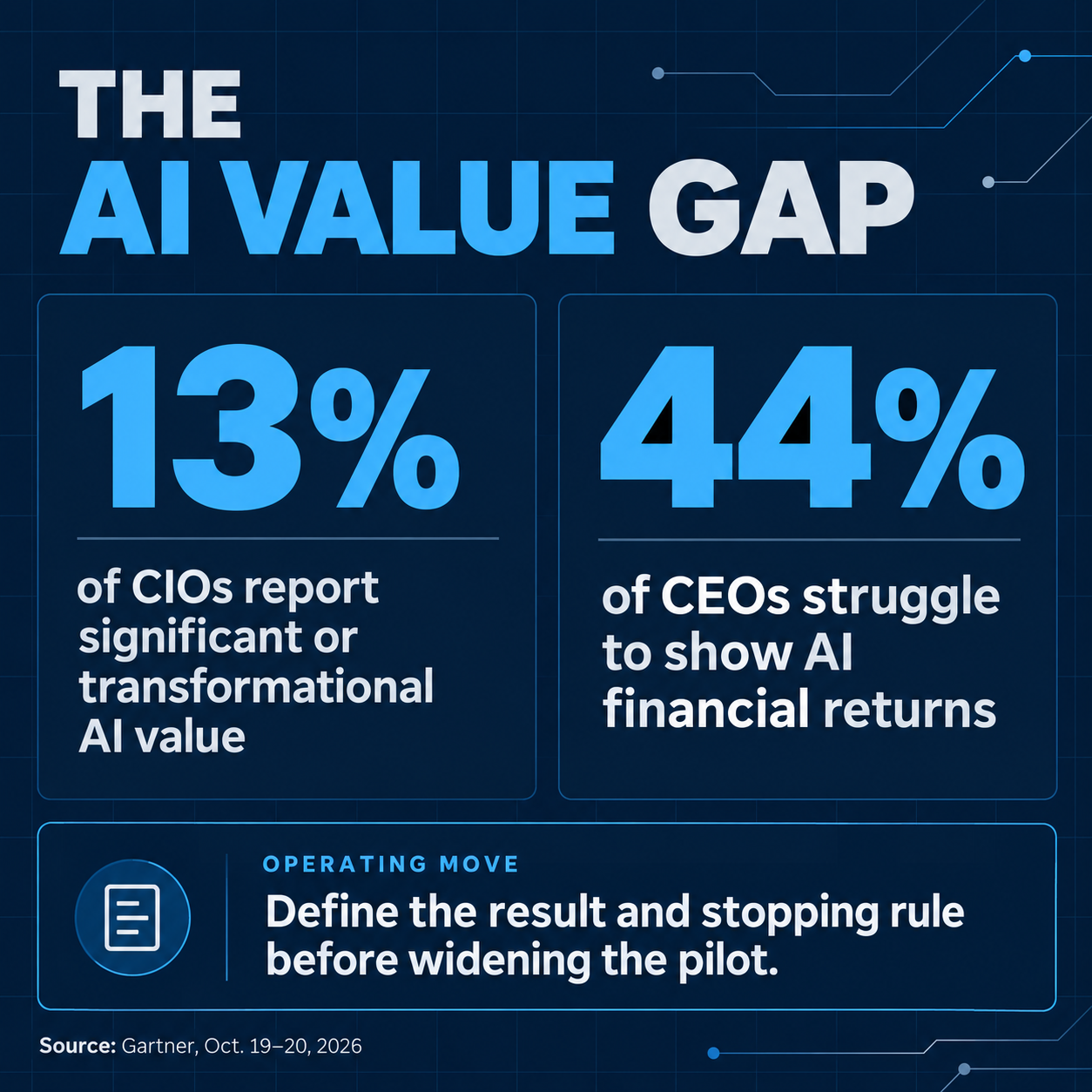
The past 72 hours made that gap hard to ignore. New survey coverage says only 13% of CIOs report significant or transformational value from AI, while 44% of CEOs struggle to demonstrate AI financial returns. At the same time, vendors opened new model routes, introduced agent registries and pushed security enforcement outside the agent itself. The common lesson is practical: capability is widening, but value still depends on a bounded workflow and a decision rule.
The opportunity for a Canadian smaller organization is real. It can buy better model choice, more useful automation and clearer usage controls without building everything itself. The tradeoff is that every new route adds identity, data, cost and vendor questions. A realistic reason not to adopt a capability is that the task is infrequent, the baseline is already reliable or nobody owns the exceptions. A checklist, a form or a deterministic rule may still be the better tool.
Illustrative scenario: A regional accounting practice tests an assistant on 30 sanitized intake packages. It can extract fields and flag missing documents but cannot update the client record or send a message. The team accepts a result only when every extracted value links to its source page, the reviewer changes fewer than two fields and the cost stays below the agreed case limit. After two weeks, the practice stops the trial because exception handling still takes longer than manual intake. The test is successful: it produced a useful no-go decision before client data or a long contract was involved. This scenario is illustrative, not a reported case.
1. Put the stopping rule beside the value target
What happened. InformationWeek's account of Gartner's new CIO research says only 13% of respondents have realized significant or transformational AI value and that the likelihood of a use case succeeding remains about one in five. A separate summary of Gartner's CEO survey says 44% of CEOs struggle to demonstrate financial returns from AI and 63% identify operating-model redesign as a leading move. These are survey findings from large organizations, not a forecast for every Canadian firm.
Why a smaller organization should care. A pilot can look busy while creating little accepted work. Staff may use the tool, managers may praise the demo and the invoice may still rise without a measurable customer, revenue, cost or risk result. The opportunity is to make a small trial easier to fund because success and failure are visible. The tradeoff is that a hard stopping rule may end a promising idea before the team has learned enough.
A useful first test this week. Write four lines before approving the next trial: the result, the current baseline, the minimum improvement and the stop date. Add one reason to continue despite missing the target, such as a verified safety improvement. Review the lines with the workflow owner and finance lead, not only the vendor or technical team.
What remains uncertain. Survey respondents may define value differently, and large-enterprise experience may not transfer to a ten-person firm. The useful pattern is not the percentage. It is the discipline of agreeing on evidence before activity starts.
2. Treat model choice as a governed route
What happened. Google Cloud announced that selected OpenAI models are rolling out in private preview through its model garden. The offering is described with marketplace purchasing, authenticated identities, unified audit logs, data perimeters and future zero-data-retention options. General availability and several controls are still described as coming soon.
Why a smaller organization should care. More model choice inside an existing cloud account may simplify contracting and let a team compare cost, speed and quality without rebuilding every connection. It can also make the cloud platform, rather than the model, the durable control point. The tradeoff is that consolidated buying can deepen dependence on one marketplace, identity system and logging format.
A useful first test this week. Choose one read-only task and run the same ten sanitized cases through two approved models behind one gateway. Keep the prompt, context and scoring method fixed. Record accepted results, corrections, elapsed time, direct usage cost, identity and log location. Ask whether the team can export the evidence in a usable format before widening the route.
What remains uncertain. Private preview is not production availability, and vendor descriptions of governance are not proof that a specific configuration meets a contract or Canadian privacy obligation. If the current provider already meets the need and switching would add review work without a better result, there may be no reason to add another model.
3. Give every agent an owner and a separate identity
What happened. Microsoft described agents as potential "agentic insiders" because they may hold data and tool access while adapting their plans. Its accompanying security detail says agents need discovery, a registry, an accountable owner and an identity distinct from the person sponsoring them. Microsoft is also selling products in this area, so its framing is both technical guidance and vendor positioning.
Why a smaller organization should care. A shared employee account hides which agent acted and makes removal harder when a pilot ends. A separate identity can narrow permissions, attribute actions and let the business disable one workflow without disrupting a person. The opportunity is safer delegation. The tradeoff is more administration and the chance that strict permissions block legitimate cases.
A useful first test this week. Inventory every assistant that can read a company system or call a tool. For each one, name the business owner, technical owner, purpose, data scope, permitted actions and expiry date. Pick one agent using a person's credentials and move it to a distinct, read-only identity. Confirm that revoking that identity stops the workflow cleanly.
What remains uncertain. Identity alone does not make an agent safe. Tokens can leak, connected tools can interpret permissions differently and a named owner may not review logs. If the system cannot support a distinct identity or bounded access, keep it away from live customer and financial records.
4. Put the guard outside the thing being guarded
What happened. NVIDIA announced an OpenShell reference architecture that separates agent workloads from governance, isolation, observation and enforcement. Its technical explanation says Sentry can inspect activity and enforce access from a hardware trust domain outside the agent's reach. This is a vendor architecture tied to NVIDIA infrastructure; it is not evidence that every business needs specialized hardware.
Why a smaller organization should care. The principle travels farther than the product. An agent cannot be the final authority on whether its own action was allowed. Approval rules, credentials, spending caps and logs work better when a deterministic service or human reviewer controls them. The opportunity is to contain failures without removing every useful capability. The tradeoff is latency, integration work and false refusals.
A useful first test this week. Take one consequential action, such as sending a quote or changing a customer status. Move authorization into a separate service or review queue. Have the agent submit a typed request with the target, reason and evidence. Test an allowed case, a case above the value limit and an instruction hidden in an uploaded document. The outside control must decide each case.
What remains uncertain. Hardware isolation may be justified for high-scale or regulated workloads but excessive for ordinary document assistance. A smaller team can often start with separate credentials, allow-listed tools, network rules and an approval queue. If those basic controls are missing, new hardware will not repair the operating gap.
5. Budget the workflow, not just the seat
What happened. Notion announced a new model router, longer-running agents, usage controls and a credit system. It reports that its Auto route produced similar results to selected frontier models at about 90% lower average cost across more than 20 tested knowledge-work cases. Its help documentation says monthly allowances are separated by usage type, workspace-funded overages can be enabled and affected functions pause when credits run out. These are Notion's own tests and billing rules.
Why a smaller organization should care. AI inside a familiar workspace can move from a fixed seat expense to a variable workflow expense. An agent that runs for hours or connects to several tools may consume budget differently from a short writing request. The opportunity is better routing and visibility. The tradeoff is a new unit that staff may not understand and an incentive to optimize credits instead of business results.
A useful first test this week. Assign one monthly workflow budget to an owner. Track runs, accepted results, corrections and credits or dollars for four weeks. Set an alert at 60% and a pause at 80% until the owner reviews the forecast. Compare automatic routing with one manually selected model on a small sample before accepting the vendor's savings claim.
What remains uncertain. Credits are not a standard unit across vendors, and included allowances may change. A cheaper route may also change quality or latency. If usage is low and predictable, a simple seat may remain easier to manage than a detailed internal chargeback.
6. Use Canada's adoption gap to choose a smaller first decision
What happened. Statistics Canada reports that 25.2% of businesses planned to use AI over the next 12 months in the third quarter of 2026, up from 10.6% two years earlier, while 22.1% were unsure. Among businesses planning use, data analytics, large language models and virtual agents were the most common applications. BDC's Canadian small-business guidance says an AI investment needs a specific and measurable business need. The national data describes intent across many industries, not readiness in a particular company.
Why a smaller organization should care. More firms are considering AI, but uncertainty remains almost as large as planned adoption. That is room for a better decision, not pressure to buy quickly. The opportunity is to start with an existing product or a narrow custom test that improves one result. The tradeoff is management attention, training and process cleanup that may cost more than the licence.
A useful first test this week. Build a one-page decision packet for one workflow: current volume, cycle time, correction rate, owner, data involved, permitted action, expected gain, weekly budget and stopping rule. Compare three routes—no change, an off-the-shelf feature and a bounded custom test. Choose the smallest route that can answer the business question within 30 days.
What remains uncertain. Planned use does not guarantee realized value, and a national average can hide large differences by sector, region and firm size. If the baseline is unknown or staff cannot absorb another change, measuring the current process may be the highest-value move.
Highest-value moves
- Give the next AI test one accepted result, one baseline, one budget and one stop date.
- List every agent that can reach company data, then assign each an owner, a separate identity and an expiry date.
- Keep approval, spending limits and evidence outside the agent for any action that can affect a customer, record or payment.
Today's strongest thesis
Buy the wider capability only after the workflow has a smaller promise it can prove.
Verified sources
- InformationWeek: Gartner: CIOs must balance AI value with risk — and fast
- Innovation Vista: Only 11% of CIOs Are AI Vanguards — What to Do If Yours Isn't Yet
- Google Cloud: Google Cloud expands model choice and flexibility, bringing OpenAI models to customers
- Microsoft: Securing the agentic insider
- Microsoft Security: Agents are your newest insiders. Security must move at their speed.
- NVIDIA: NVIDIA Launches OpenShell Reference Architecture for Safe AI Agents
- NVIDIA Developer: Inside NVIDIA Sentry: Secure AI Agents at Runtime
- Notion: Agents, rebuilt to do more for less
- Notion Help Center: Manage your AI credits
- Statistics Canada: Analysis on planned use of artificial intelligence by businesses in Canada, third quarter of 2026
- Business Development Bank of Canada: 3 ways to create value with AI in your business
Continue your decision path
Move from understanding to action.
Make the Receipt Part of the Work
New cost, privacy, security and Canadian adoption signals point to one practical rule: delegate only when the workflow returns usable evidence.
Read nextApply this signal to your architecture.
Identify the workflow, context, and controls to structure first.
Open Architecture Assessment