Operating question
Funding, training and connected AI create value only when a business can name the workflow, owner, evidence, permissions and stopping path before adoption begins.
AI Operating Models
Bring a Workflow, Not a Wish List
For
Leaders and workflow owners
You will leave with
4 operating decisions
Reading mode
11 min · 11 verified sources
Reading guide8 sections · Canadian briefing+
Highest-value moves
- 01Prepare a one-page workflow brief before pursuing public funding, training or a new agent platform.
- 02Turn general AI training into a supervised test with real cases, exceptions and one changed procedure.
- 03Inventory every connected knowledge source, credential, owner and shutdown step for AI-enabled work.
- 04Require a signed, bounded handoff before an agent can trigger a consequential business action.
New Canadian funding, small-business training and connected-agent controls point to one practical move: define the workflow before choosing the opportunity.
Today's strongest signal: the market is making AI easier to fund, teach and connect, but a smaller organization still needs to bring one named workflow to the table. Picture a 55-person Ontario food manufacturer looking at a grant, a training program and a new agent platform in the same week. The useful question is not which offer sounds most advanced. It is which one can improve a known handoff—such as turning an approved retailer order into a production plan—without giving the tool authority it does not need.
The preceding 72 hours brought a striking combination. Canada expanded regional support for business adoption. A large U.S. small-business program paired capital with AI training. Technology vendors added process context, agent inventories, cost controls and payment execution. Taken together, the signal is not simply that more AI is available. It is that money, context and action are moving closer to ordinary work.
That creates opportunity for Canadian SMEs. A team can use public support, existing software and practical training to improve a narrow process without building an AI department. The tradeoff is that a connected workflow carries more business data, more permissions and more ways to create a quiet error at scale. A realistic reason not to adopt a capability is that the current process is low-volume, already dependable or too poorly documented to automate safely. Fixing the form, ownership or handoff may deliver the better return.
Illustrative scenario: A regional industrial supplier wants help triaging 70 weekly quote requests. Its workflow brief names the owner, current two-day turnaround, required source documents, approved price list and the rule that a person must approve every customer-facing quote. The team tests 25 sanitized requests and records accepted fields, corrections, elapsed time and cost. The tool speeds up complete requests but mishandles custom freight terms, so the supplier keeps freight cases manual and applies for support only for the bounded path. This scenario is illustrative, not a reported case.
1. Turn the funding window into a workflow brief
What happened. PrairiesCan announced that the Regional Artificial Intelligence Initiative is receiving another $500 million over five years, bringing total federal funding to $700 million. The expansion emphasizes SME adoption, commercialization and five priority sectors: health and life sciences, energy and natural resources, transportation, agriculture, and manufacturing and robotics. The live Prairies application page sets out the program route for businesses and organizations. Program fit, assessment and funding decisions remain with the government.
Why a smaller organization should care. New funding can lower the cost of an adoption project, especially where outside expertise or integration work is the real barrier. It can also tempt a team to describe a technology purchase instead of a business improvement. The opportunity is to finance a measurable change. The tradeoff is application effort, reporting work and the risk of shaping the problem around an available program.
A useful first test this week. Write a one-page workflow brief before contacting a vendor or program officer. Name the current volume, wait time, error or rework rate, business owner, data involved, permitted action and 90-day target. Add the evidence you can already produce. If the brief cannot explain what improves without naming a model, the project is not yet ready for funding.
What remains uncertain. An open program is not an approval, and the October announcement does not establish that every region, sector or expense will qualify on the same terms. An organization outside the Prairies needs to use its regional agency's current route. If the expected gain is smaller than the application and change effort, a self-funded manual improvement may be more sensible.
2. Treat training as integration work
What happened. Goldman Sachs launched a U.S. Small Business AI Institute within a new $500 million commitment for education, capital and support. Its accompanying survey of 2,473 program alumni reports that 86% use AI, but only 15% say it is fully integrated into core operations and 74% of AI-using owners have no formal employee-use policy. The sample is made up of U.S. program graduates and may be more engaged than a typical Canadian small business.
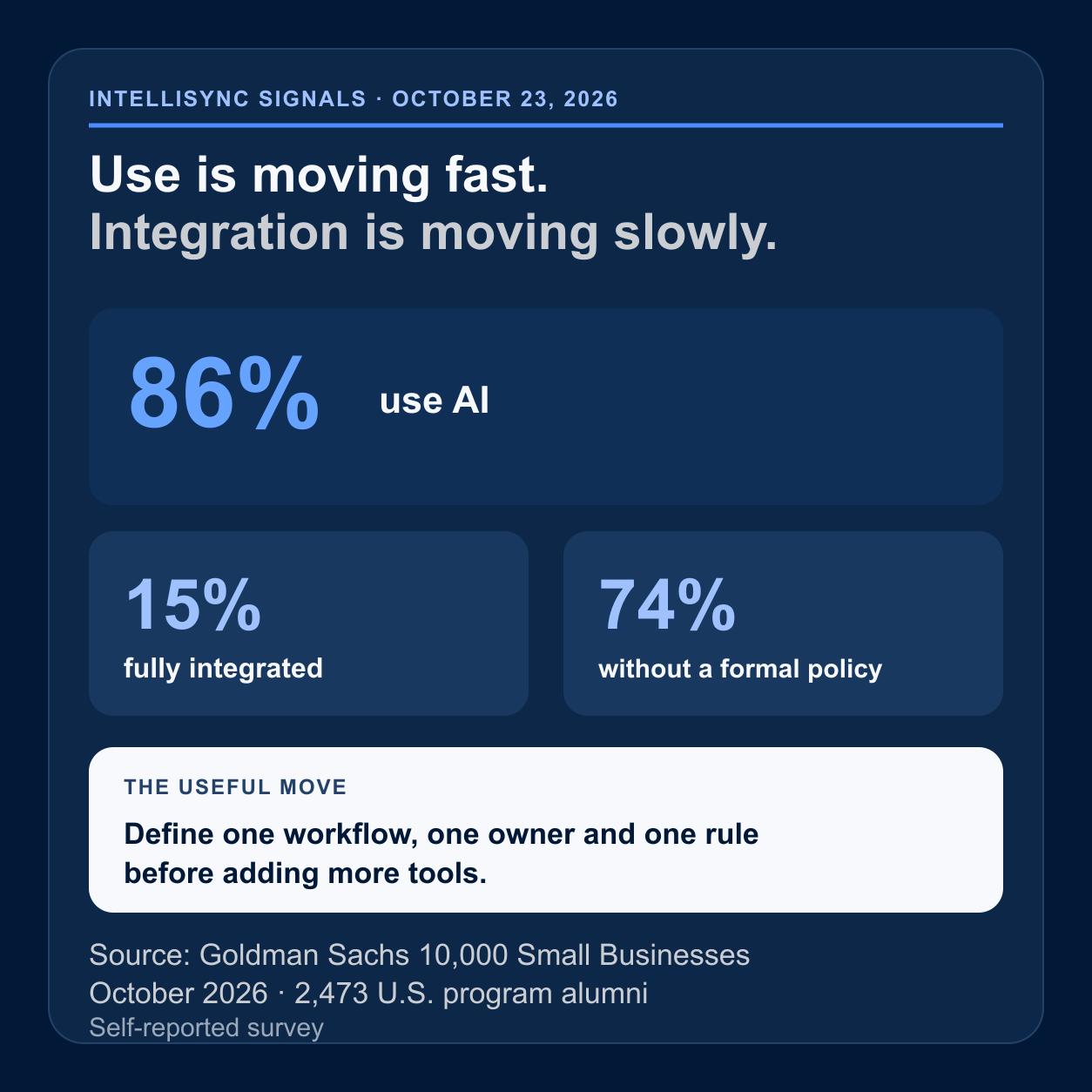
Why a smaller organization should care. Tool familiarity is not the same as an organizational capability. Staff can use chatbots every day while customer records, quality checks and approvals remain disconnected. The opportunity is to make training directly improve one job. The tradeoff is that workflow training takes time from experienced employees and can expose weak documentation.
A useful first test this week. Replace one general AI session with a supervised workflow lab. Bring ten real but sanitized cases, the current checklist and the person who owns exceptions. Have staff compare the existing method with an approved tool. Record where the tool helped, where people corrected it and what policy question appeared. Finish by changing one procedure, not by collecting prompt tips.
What remains uncertain. The survey is self-reported, U.S.-specific and tied to one program. Full integration is also not automatically desirable. A seasonal business may get enough value from occasional drafting or analysis. If the task does not recur or a policy would cost more than the exposure, limited use can be the right design.
3. Give the system process context, not every conversation
What happened. Zoom announced a Unified Context Layer that can connect meeting, chat and document history with activity in Zoom and third-party applications. Some related features are available now; others are expected later. ARIS separately introduced process context that joins roles, systems, rules, risks and controls, with availability scheduled for October 26. ARIS also cited vendor-sponsored research from large enterprises, so its percentages should not be treated as an SME benchmark.
Why a smaller organization should care. A meeting summary can become useful when it reaches the task, customer record or project plan that owns the next action. It can become risky when every conversation is treated as permanent, accurate and broadly accessible context. The opportunity is fewer dropped decisions and less manual copying. The tradeoff is retention, permission and correction work across systems.
A useful first test this week. Choose one recurring meeting with a clear output, such as the weekly production schedule. Define the five fields that may leave the meeting, the system that receives them, who can correct them and how long the source notes remain available. Use an existing automation or a manual template for two meetings before connecting an agent. Compare missing actions and corrections with the old method.
What remains uncertain. Vendor context layers use different permission models and release stages. A summary can also carry a misunderstood decision into another system. If the meeting does not produce structured commitments, better facilitation and a shared action log may beat an AI connection.
4. Test the agent inside the process it will touch
What happened. Oracle announced a no-code and low-code studio for building, testing, monitoring and governing agents inside industry application workflows. It includes reusable tools, model choice, configured permissions and usage monitoring. Cognizant announced an operating layer that meters AI spend, monitors quality, documents results and keeps human approval for critical or customer-facing decisions. Both are vendor claims about their own products.
Why a smaller organization should care. A standalone demo cannot show what happens when customer data is incomplete, a permission is missing or a downstream system rejects an update. The opportunity is to test the handoff that creates value. The tradeoff is that a realistic test needs representative cases, staff time and access controls; it is slower than a polished demo.
A useful first test this week. Build a test set around one handoff: eight normal cases, one missing-document case and one case the agent must refuse. Require a typed result with the proposed action, source evidence, confidence or exception code, and estimated cost. Run it in read-only mode. A human completes the action and records whether the proposed result was accepted, corrected or rejected.
What remains uncertain. Low-code tooling can reduce development effort without removing integration complexity. Monitoring a run does not prove the business result was correct. If the application cannot provide a safe test environment or export a usable receipt, keep the workflow manual until that boundary exists.
5. Inventory the knowledge and the off switch
What happened. IBM expanded AI asset discovery to cover more agent platforms and to treat connected knowledge bases as related assets. Its product can surface agents, tools, Model Context Protocol servers and knowledge sources across several platforms. Model Context Protocol, or MCP, is a standard way for AI systems to reach approved tools and data. OpenAI's new cyber-defence blueprint calls for clearer security responsibilities, detection of dangerous behaviour and reliable shutdown controls.
Why a smaller organization should care. A team cannot review or revoke an assistant it has forgotten. The useful asset list now includes the knowledge source, connected tool, credential, owner and stop path—not just the model name. The opportunity is a small inventory that makes renewal, incident response and staff changes easier. The tradeoff is maintenance, and an inventory that is never updated can create false confidence.
A useful first test this week. List every AI-enabled workflow that can touch company data. For each, record the owner, purpose, systems, knowledge sources, credentials, permitted actions, last review and exact shutdown step. Pick one item and have someone other than its builder stop it, revoke access and confirm that queued work cannot continue. Restore it only through the approved path.
What remains uncertain. Automated discovery may not see personal accounts, browser extensions or unsanctioned tools. Shutdown can also be incomplete when copied data remains elsewhere. If the team has only two low-risk tools, a reviewed spreadsheet may be more dependable than a governance platform.
6. Require a signed handoff before money moves
What happened. Visa announced a live pilot with BILL and Billtrust in which trusted AI agents can initiate and complete approved business invoice payments. The pilot uses agent identity, tokenized payment credentials and business-defined controls instead of shared supplier-portal passwords. Visa says the pilot is processing end-to-end transactions with participating customers and suppliers; that does not establish general availability or independent performance.
Why a smaller organization should care. Accounts payable has a clear value case: less rekeying, fewer portal logins and faster completion after approval. It also has a clear loss case: the wrong supplier, amount or timing. The opportunity is to automate execution after a valid decision. The tradeoff is concentrated financial risk and reliance on several parties' identity and fraud controls.
A useful first test this week. Do not start with payment. Start with a signed payment packet: approved invoice ID, supplier identity, amount, currency, due date, approver, permitted account and expiry time. Have an assistant assemble the packet but not submit it. Compare 20 packets with the accounting record, including a duplicate invoice, changed bank detail and amount above the limit. Advance only if the deterministic payment service rejects all three exceptions.
What remains uncertain. A vendor pilot is not proof that the same controls are available in a Canadian bank, accounting system or supplier portal. Tokenized credentials reduce some risks but do not validate the invoice itself. If supplier data is unstable or approval records are informal, automating payment execution would widen the wrong part of the process.
Highest-value moves
- Write one workflow brief with the current baseline, owner, data, permitted action and 90-day result before pursuing funding or a new platform.
- Turn one training session into a supervised test using sanitized cases, real exceptions and a procedure change.
- Inventory every connected knowledge source and credential, then prove that a second person can stop one AI-enabled workflow cleanly.
Today's strongest thesis
Bring a workflow with evidence to the opportunity, or the opportunity will choose the workflow for you.
Verified sources
- Prairies Economic Development Canada: Government of Canada expands support for artificial intelligence adoption and commercialization in the Prairie provinces
- Prairies Economic Development Canada: Regional Artificial Intelligence Initiative in the Prairie Provinces
- Goldman Sachs: Goldman Sachs Commits $500 Million to Launch Small Business AI Institute and Expand 10,000 Small Businesses
- Goldman Sachs 10,000 Small Businesses: The AI Economy Is a Small Business Economy
- Zoom: Zoom advances its AI strategy with a new Unified Context Layer that helps turn meeting conversations into completed work
- ARIS: ARIS Launches Process Context for Enterprise AI
- Oracle: Oracle AI Agent Studio for Industry Applications Helps Accelerate Business Outcomes
- Cognizant: Introducing Cognizant AI Nexus: helping enterprises govern the cost, quality and results of AI
- IBM: Expanding AI Asset Discovery for broader visibility
- OpenAI: Democratic governance of frontier AI, part II: Empowering cyber defenders
- Visa: Visa Announces Enhanced Capabilities That Can Bring Trust and Control to the Future of Business Payments
Continue your decision path
Move from understanding to action.
Daily Signal: Fund the Handoff, Not Just the Tool
Six practical signals on Canadian AI policy, deployment skills, agent security, public inventories, vendor corrections and accountable review.
Read nextApply this signal to your architecture.
Identify the workflow, context, and controls to structure first.
Open Architecture Assessment